Struggling to Eat Enough Protein Every Day? Here’s the Simplest Way
(Review By Passion Health Physician)
You feel tired all the time. Your meals don’t keep you full. And somehow, your clothes keep getting tighter.
The missing piece? Protein.
Most people focus on cutting carbs or avoiding fat… but completely ignore the one nutrient that controls hunger, supports muscle, and keeps your metabolism active.
Here’s the truth:
If you’re not eating enough protein every day, your body starts breaking down muscle, your cravings increase, and your energy crashes.
But there is good news. You can fix this today without counting every gram or following a complicated diet.
This article shows you the simple way to eat enough protein every day. No nonsense. No expensive meal plans. Just real food and small shifts that work.
Ready to take control of your health? Book a primary care appointment with Passion Health Primary Care today. Get a plan that fits your life.
The Hidden Danger of Not Eating Enough Protein Every Day
Most people think protein is only for bodybuilders. Wrong.
Protein builds every cell in your body. It makes hormones, enzymes, and antibodies. Without enough protein, your body slowly falls apart.
Here is what happens when you consistently fail to eat enough protein every day:
Muscle loss. Your body breaks down muscle tissue for energy. Less muscle means a slower metabolism.
Blood sugar crashes. Protein stabilizes glucose. Without it, you ride a rollercoaster of energy spikes and slumps.
Uncontrollable cravings. Protein controls hunger hormones. Low protein = constant snacking on junk.
Weak bones and hair. Your body prioritizes vital organs first. Hair thins. Nails crack. Bones weaken.
Slow recovery. Every cut, bruise, or workout takes twice as long to heal.
Slower metabolism — Less muscle means fewer calories burned at rest, which quietly leads to weight gain.
Weakened immunity — Antibodies are proteins. Low intake means a weaker defence system.
How Much Protein Do You Actually Need Each Day
The Numbers You Should Know
Most health guidelines suggest 0.8 grams of protein per kilogram of body weight. However, research consistently shows that active adults, older individuals, and anyone trying to manage their weight need significantly more, closer to 1.2 to 1.6 grams per kilogram.
For a 70 kg adult, that means targeting between 84 and 112 grams of protein daily.
Here is what that looks like in simple terms:
A large egg provides about 6 grams
A palm-sized chicken breast provides about 30 grams
One cup of Greek yogurt provides about 17 grams
A scoop of whey protein provides about 25 grams
When you see those numbers, you quickly realize that hitting your daily target requires consistent effort at every meal — not just one high-protein dinner.
How to Eat Enough Protein Every Day: The Simple Way
Stop overcomplicating. You do not need a kitchen scale or a nutrition degree.
The simple way to eat enough protein every day follows one rule: Protein first, then everything else.
Start Every Meal with Protein
Before you touch bread, rice, or fruit, eat your protein.
Why? Because protein triggers satiety hormones. It slows digestion. It prevents blood sugar spikes. And most importantly, you will automatically eat fewer empty calories later.
Try this tomorrow:
Breakfast: Eat two eggs before your oatmeal or toast.
Lunch: Eat your chicken or tofu before your salad or wrap.
Dinner: Eat your fish or beans before your potatoes or pasta.
That one change alone helps most people eat enough protein every day without tracking anything.
Spread Protein Across All Meals
Do not save protein for dinner. That is the number one mistake.
Your body cannot store protein. It needs a steady supply every three to four hours. Eating 50 grams at dinner does not fix a zero-protein breakfast.
The simple way to eat enough protein every day means getting 20–40 grams at each meal.
Quick visual guide for one meal:
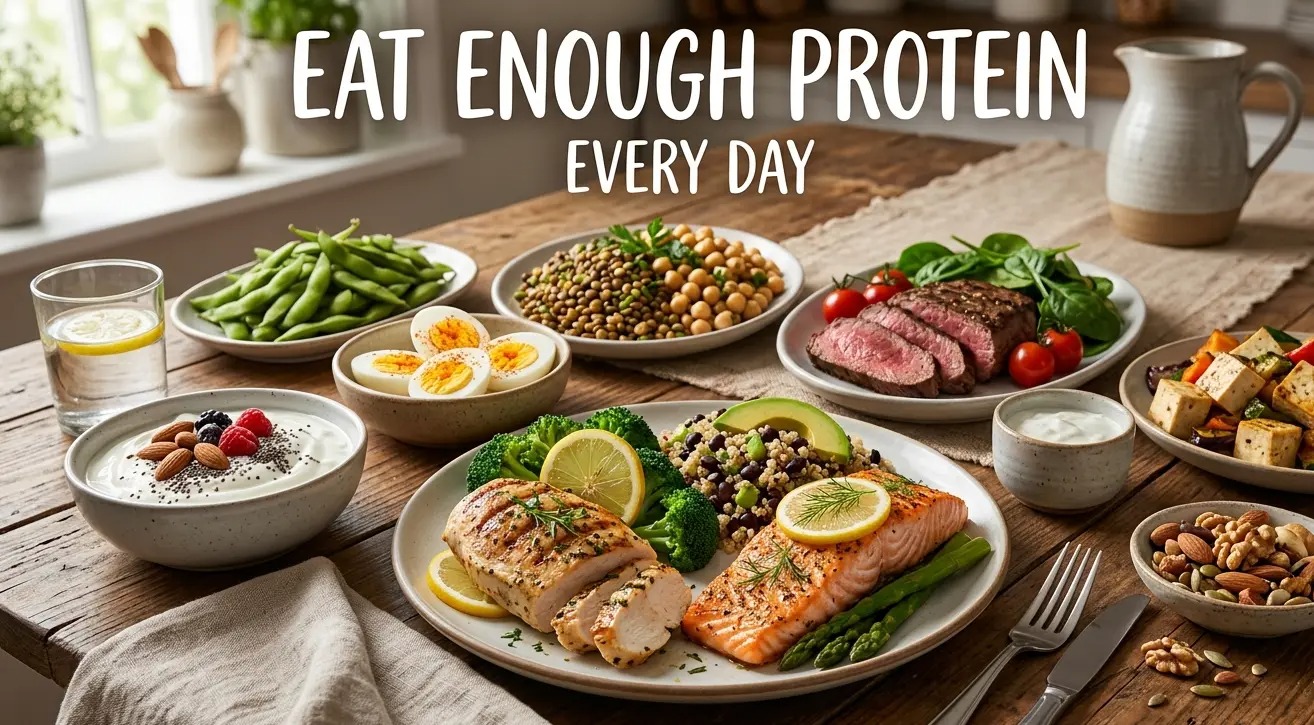
Palm-sized piece of meat, fish, or tofu (20–25g)
Plus one egg (6g)
Plus a half cup of Greek yogurt (10–12g)
That already puts you over 35 grams in a single sitting.
Simple Breakfast Swaps That Work
Breakfast is where most people fail—cereal, toast, pancakes, smoothie bowls – all carbs, almost no protein.
Here are easy swaps to eat enough protein every day, starting with your first meal:
Instead of cereal → three eggs + one slice of cheese (25g protein)
Instead of a bagel → Greek yogurt with a handful of almonds (20g protein)
Instead of oatmeal alone → oatmeal mixed with one scoop of whey or collagen (25g protein)
Instead of a fruit smoothie → add one scoop of unflavored protein powder and two tablespoons of peanut butter (30g protein)
These swaps take the same amount of time. But the difference in energy and hunger lasts all morning.
Smart Snacking for Protein Success
Snacks ruin most people’s protein goals. Chips, pretzels, granola bars – zero protein, all calories.
Replace those with protein‑dense snacks. Keep them visible. Put them in your bag, your desk, your car.
Best easy snacks to eat enough protein every day:
Hard‑boiled eggs (6g each) – make six on Sunday
Cottage cheese single cup (14g)
Greek yogurt tube or drinkable yogurt (12–15g)
Cheese sticks (7g each)
Roasted edamame or chickpeas (11g per quarter cup)
Beef or turkey jerky (10g per serving)
Almonds or walnuts (6g per handful)
No prep. No cooking. Just open and eat.
Why Timing Matters – Spread Protein Throughout the Day
You already know you need protein. But when you eat it changes everything.
Research shows that eating 25–30 grams of protein per meal boosts muscle synthesis more effectively than eating 60 grams at one meal and 10 grams at another.
Your body uses protein best in smaller, even doses.
Sample daily schedule to eat enough protein every day, the simple way:
Meal | Example | Protein |
Break fast | 3 eggs + 1 oz cheese | 25g |
Morning snack | Greek yogurt (150g) | 15g |
lunch | Chicken breast (150g) + quinoa | 40g |
After snack | Cottage cheese (half cup) | 12g |
Dinner | Salmon (150g) + lentils | 45g |
Total | 137g |
The Best Protein Sources for Everyday Use
You do not need exotic ingredients. The simple way to eat enough protein every day uses foods you already know.
Animal‑Based Proteins (fast absorption)
Eggs – complete protein, cheap, versatile
Greek yogurt – higher protein than regular yogurt
Cottage cheese – casein protein digests slowly, great before bed
Chicken breast – lean and easy to cook in bulk
Lean beef or pork – also provides iron and B12
Fish (tuna, salmon, cod) – protein plus healthy fats
Plant‑Based Proteins (fiber + nutrients)
Tofu or tempeh – 15–20g per half block
Lentils and chickpeas – 12–15g per cup
Edamame – 17g per cup
Quinoa – 8g per cup (a complete plant protein)
Nuts and seeds – pumpkin seeds (10g per quarter cup)
Supplements for Convenience (not required, but helpful)
Whey protein – digests fast, perfect post‑workout or in smoothies
Collagen peptides – 18–20g per scoop, flavourless, mixes into coffee or tea
Plant protein powder – pea or rice blends
Common Mistakes That Keep People Protein-Deficient
Relying only on plant sources without combining them — Individual plant proteins are often incomplete. Combine grains with legumes to cover all essential amino acids
Skipping breakfast protein — Starting the day with carbohydrates alone creates a deficit that you rarely recover by dinner
Assuming salads are enough — A salad without eggs, chicken, beans, or cheese is largely fibre and water. Nutritious — but not a protein meal
Not tracking even loosely — You do not need to obsess over numbers, but a rough sense of your daily intake reveals blind spots quickly
Relying on protein bars as a primary source — Bars are useful supplements, not meal replacements for whole food protein
Your Simple 3-Step Action Plan
Getting started does not require a complicated overhaul. These three steps alone will move you meaningfully in the right direction.
Step 1 — Audit your current intake. For three days, write down everything you eat and estimate the protein content. Most people are surprised by how far below their target they actually fall.
Step 2 — Anchor every meal with a protein source. Before building any meal, ask yourself: where is my protein coming from? Eggs, meat, fish, dairy, legumes, or a shake — pick one and build the rest of the meal around it.
Step 3 — Replace one snack daily with a high-protein option. You do not need to change everything at once. Swapping one biscuit break for a handful of almonds and a Greek yogurt creates a habit that compounds over weeks.
How Protein Stabilizes Blood Sugar and Prevents Chronic Disease
Here is the part most articles leave out. Eating enough protein every day, the simple way, does more than build muscle.
It protects you from chronic disease.
Protein slows the absorption of sugar into your bloodstream. When you eat carbohydrates alone – bread, rice, fruit, soda – your blood sugar spikes. Then it crashes. Then you crave more carbs.
That cycle, repeated for years, leads to insulin resistance, prediabetes, and type 2 diabetes.
Protein breaks that cycle.
How protein helps long‑term health:
Lowers blood sugar after meals by 30–40% compared to carb‑only meals
Reduces triglycerides and improves cholesterol profiles
Preserves lean muscle mass as you age – muscle loss (sarcopenia) is a major cause of falls and fractures in older adults
Keeps you fuller for longer, which naturally reduces calorie intake without willpower
Multiple studies show that people who consistently eat enough protein every day have lower rates of obesity, metabolic syndrome, and cardiovascular disease.
The Bottom Line
Getting enough protein isn’t a trend—it’s essential for staying strong, maintaining weight, and supporting overall health. Small, consistent changes can make a big difference.
Don’t wait. Book an appointment with Passion Health Primary Care and get a plan that fits your needs. Take charge of your health today.
Reviewed By Passion Health Physician