
Intestinal Obstruction: How to Recognize the Signs
Don’t Ignore That “Just a Stomach Pain
Imagine waking up with a sharp, cramping pain in your belly that just won’t go away.
At first, you might dismiss it as something you ate or a simple case of gas. But as the hours pass, the bloating worsens, nausea sets in, and you realize you haven’t been able to pass gas or have a bowel movement all day.
That nagging discomfort could be more than a simple stomach ache; it could be a serious threatening intestinal obstruction.
At Passion Health Primary Care, we understand how stressful and concerning abdominal symptoms can be, and we are here to help you navigate these health scares with expert care and compassion.
Concerned about your symptoms? Book an appointment with Passion Health today.
What is an Intestinal Obstruction?
To put it simply, an intestinal obstruction is a blockage that keeps food or liquid from passing through your small intestine or large intestine (colon). Think of your digestive tract as a long, hollow pipe. When that pipe gets crimped, clogged, or twisted, nothing can get through.
When this happens, your body can respond with intense symptoms. Not only does the blockage cause extreme pain, but it also may reduce blood flow to parts of your bowel, which can lead to tissue death—a condition that is can become dangerous without timely treatment
There are two main types:
Mechanical Obstruction: A physical barrier (like scar tissue or a tumor) blocks the intestine.
Ileus (Functional Obstruction): The intestines look normal, but the muscles or nerves aren’t working properly, meaning they can’t push waste through.
Early Signs: When “Stomach Pain” Becomes a Warning
How do you know if your discomfort is serious? Intestinal obstructions usually announce themselves with a distinct set of symptoms that go beyond typical indigestion.
If you are experiencing the following, do not try to “wait it out”:
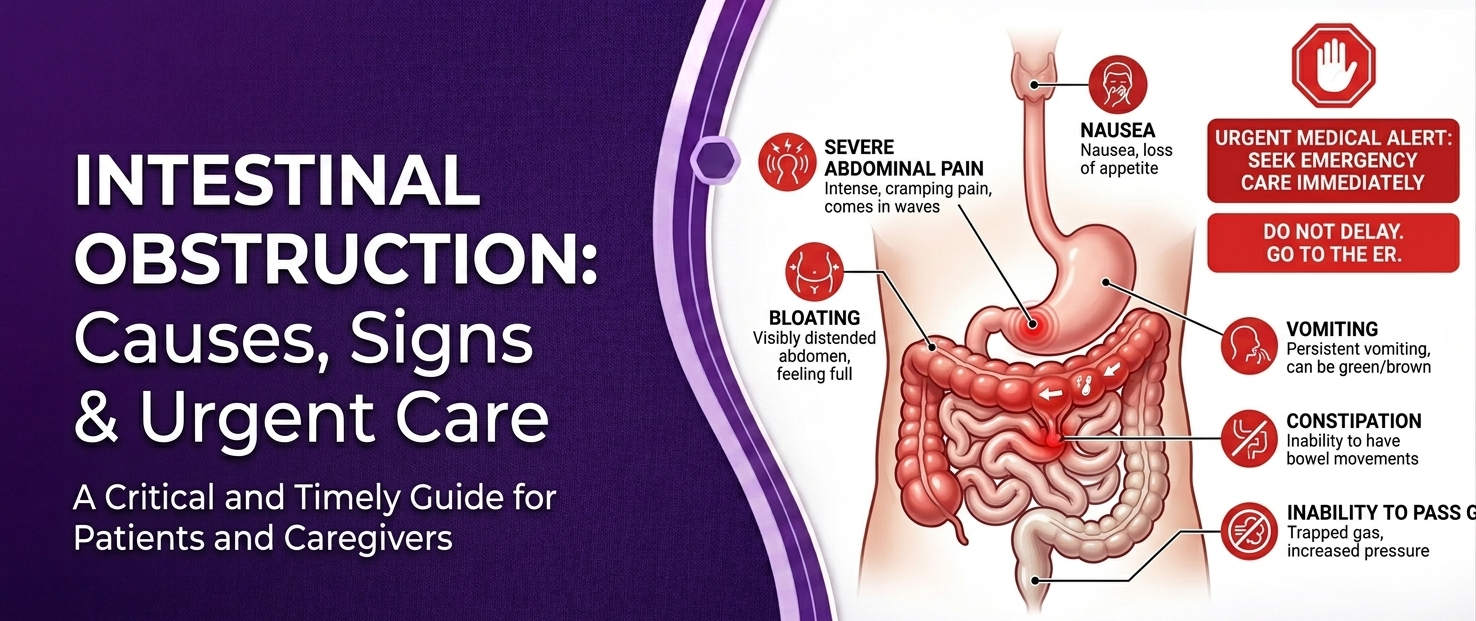
Severe Cramping: Unlike a dull ache, obstruction pain often comes in waves. You might feel a sharp, colicky pain that intensifies and then subsides as the intestines try to push past the blockage.
Bloating and Distension: Your abdomen may swell visibly, becoming hard to the touch.
Nausea and Vomiting: If the blockage is high in the small intestine, you may vomit frequently, often green bile.
Inability to Pass Gas or Stool: This is an important warning sign
. If you haven’t had a bowel movement or passed gas in 24 hours, your digestive system is likely at a standstill.
Constipation: While constipation is common, sudden, absolute constipation (where nothing moves) combined with pain is a hallmark sign of a full blockage.
The Hidden Causes: What Puts You at Risk?
Understanding intestinal obstruction causes and treatment starts with knowing who is at risk. Many of these causes develop silently over time.
Adhesions: This is the most common cause. These are bands of scar tissue that form after abdominal or pelvic surgery. They can twist or pull the intestine out of place.
Hernias: A hernia occurs when part of the intestine bulges through a weak spot in the abdominal wall. If the hernia becomes trapped (incarcerated), it can cut off blood flow.
Colon Cancer: Tumors in the colon are a leading cause of large bowel obstructions.
Crohn’s Disease: This inflammatory bowel disease causes the intestinal walls to thicken and narrow over time.
Volvulus: A “twisted” intestine, often occurring in older adults or those with chronic constipation.
Intussusception: More common in children, this occurs when the intestine “telescopes” into itself.
Not sure if these symptoms apply to you? Talk to a doctor today.
Why is this condition alarming?
There is a reason we emphasize urgency. An intestinal obstruction is not something that resolves with over-the-counter antacids.
If left untreated, the pressure inside the intestines builds. This can lead to:
Strangulation: The blood supply to the bowel is cut off. Without blood, the affected tissue begins to die (necrosis) within hours.
Perforation: The weakened bowel tissue may develop a tear
Peritonitis: If the bowel perforates, bacteria and waste spill into the abdominal cavity, causing a massive, serious infection requiring immediate medical attention.
These complications often require emergency surgery and prolonged hospital stays. However, if caught early—often at the primary care level—many obstructions can be managed without surgery.
When to See a Doctor
You know your body best, and persistent symptoms should never be ignored. However, many patients delay seeking help because they fear the diagnosis or think they will be seen as “dramatic.”
You should seek immediate medical attention if:
Your pain is severe and localized (focused on one spot).
You are vomiting consistently.
Your abdomen is rigid or hard.
You have a fever along with abdominal pain (this suggests infection).
You have a history of abdominal surgery and suddenly cannot pass gas.
You don’t need to go straight to the emergency room for a consultation. At Passion Health Primary Care, our physicians can assess your symptoms immediately. We help you navigate the line between “wait and see” and “urgent care.” We are your first line of defense.
Diagnosis: How Passion Health Physicians Can Help
When you come to Passion Health with abdominal pain, we don’t just treat the symptom; we find the root cause.
Our physicians start with a detailed history and physical exam. We listen to your abdomen with a stethoscope—a silent abdomen can indicate a lack of movement, while high-pitched noises can suggest a blockage trying to push past an obstacle.
Depending on your symptoms, we may order imaging:
Abdominal X-ray: Shows the location of gas and fluid, often revealing dilated loops of intestine.
CT Scan: This is the gold standard for diagnosing obstructions. It shows the exact location of the blockage, the cause (tumor, scar tissue), and whether there is any strangulation.
By diagnosing early, we help you avoid the stress of emergency treatment and ensure you are treated by a team that understands your history.
Treatment Options: From Medical Management to Surgery
The treatment for an intestinal obstruction depends entirely on the cause and severity. Here is how we approach it at Passion Health, ensuring you are referred to the right specialists at the right time.
1. Non-Surgical Management (Stabilization)
If the obstruction is partial or caused by a functional ileus, surgery may not be needed immediately. Treatment often includes:
Bowel Rest: You stop eating solid food to allow the intestines to rest.
IV Fluids: Dehydration is a major risk with vomiting; we ensure your electrolytes and hydration are stable.
Nasogastric Tube (NG Tube): A thin tube is inserted through the nose into the stomach to suction out air and fluid, relieving pressure and bloating.
2. Non-Surgical Procedures
For certain types of obstructions (like those caused by colon cancer or strictures), a doctor may place a self-expanding metal stent using a colonoscope. This opens the bowel without an incision, acting as a bridge to surgery or long-term relief.
3. Surgical Intervention
If the blockage is complete or if there are signs of strangulation (damaged tissue), surgery is essential. Surgeons will remove the blockage and, if necessary, remove any dead sections of the bowel. In some cases, a colostomy or ileostomy (temporary or permanent) may be required.
What This Means for You
Hearing the words “intestinal obstruction” can be frightening, but here is the reality: treatment is highly effective when the condition is caught early.
uncertainty about symptoms, not knowing if your stomach pain is a mild inconvenience or a dangerous blockage—can be overwhelming. You don’t have to navigate that fear alone.
At Passion Health Primary Care, we take a patient-first approach. We don’t dismiss your pain as “just stress” or “just gas.” We take the time to understand your history, run the necessary tests, and provide a clear roadmap for recovery.
If you have a history of surgery, Crohn’s, or cancer, regular check-ups with your primary care provider are essential to catching adhesions or hernias before they become emergencies.
Don’t Ignore Early Warning Signs
Your body is always sending signals. While stomach pain is common, certain signs—like the inability to pass gas, severe cramping, and vomiting—are your body’s way of sounding an alarm for an intestinal obstruction. Understanding the intestinal obstruction causes and treatment options is the first step, but action is the only step that leads to healing. You don’t have to live in fear of your next meal or your next stomach cramp. Let the compassionate team at Passion Health Primary Care give you the peace of mind you deserve.
Book your appointment with Passion Health Primary Care today and take control of your health.
Frequently Asked Questions (FAQs)
1. Can an intestinal obstruction clear up on its own?
A partial obstruction may resolve with conservative management (like bowel rest and fluids), but a complete obstruction rarely resolves without medical intervention. Attempting to treat a severe blockage at home can lead to bowel perforation, which is life-threatening.
2. How long can you survive with a bowel obstruction?
This varies, but signs of strangulation (loss of blood supply) can become critical within 12 to 24 hours. If you suspect a total blockage, you must seek medical care immediately.
3. What is the most common cause of intestinal obstruction?
For the small intestine, adhesions (scar tissue from previous surgery) are the most common cause. For the large intestine, colon cancer is the leading cause of obstruction.
4. How do doctors tell the difference between constipation and a blockage?
Constipation usually involves hard stool and straining, but not the severe, cyclic vomiting and localized sharp pain seen in obstructions. Imaging tests like a CT scan or X-ray are required to make the distinction definitively.
5. What should I eat after treatment for an obstruction?
After treatment, you will likely start on a low-fiber diet to allow your intestines to heal. Your Passion Health physician will provide a specific nutritional plan tailored to your recovery.