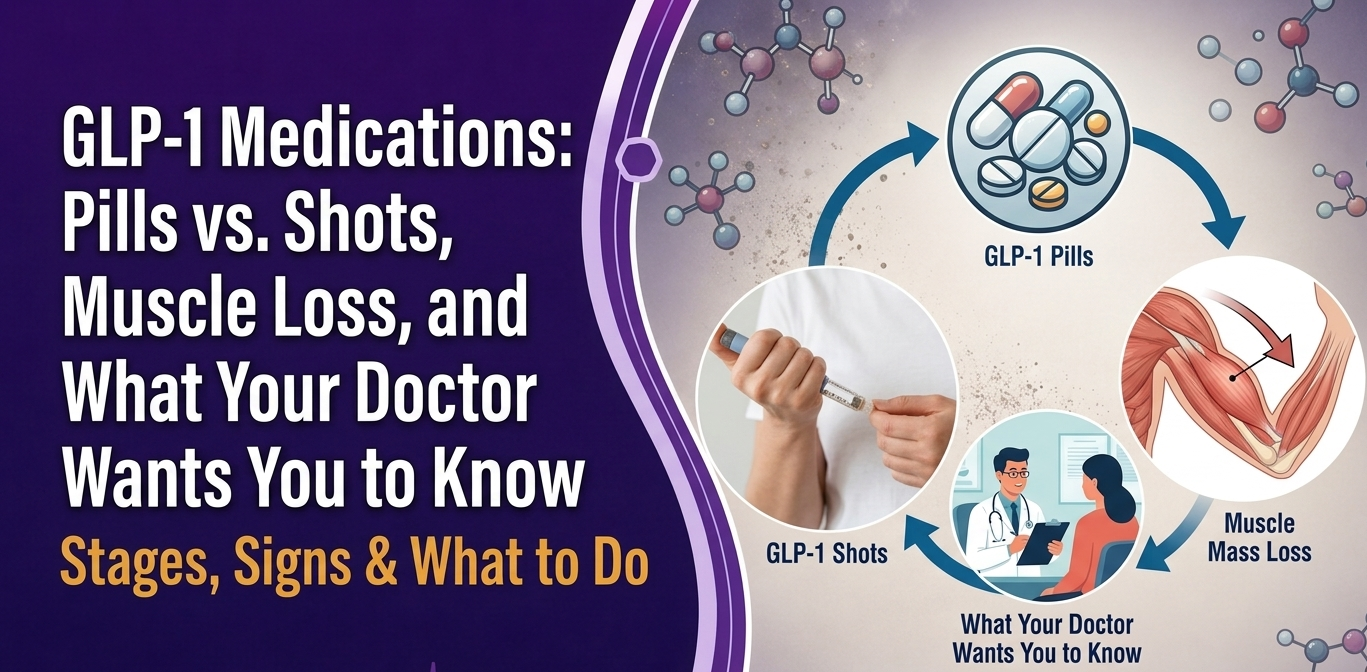
GLP-1 Pills vs Shots: Do They Cause Muscle Loss?
A question many patients now ask in clinic is: “If I lose weight on GLP-1 medications, will I also lose muscle?” Others want to know whether newer GLP-1 pills work as well as injections like Wegovy or Zepbound.
These concerns are understandable. Many people using GLP-1 medications notice rapid weight loss, lower appetite, and changes in body composition.
News headlines and social media discussions have also raised fears about “muscle wasting” linked to these drugs.
At the same time, oral GLP-1 pills are becoming more available, giving patients another option besides weekly injections.
In practice, the answer is more nuanced than many headlines suggest. Some lean mass loss can occur during any major weight-loss program — including GLP-1 treatment — but recent research suggests the muscle loss may not be as severe as experts once feared. Exercise, protein intake, age, and overall nutrition all play major roles.
This guide explains how GLP-1 pills and shots compare, what research says about muscle loss, and what doctors recommend to protect strength during treatment.
Seek medical attention immediately if you develop severe vomiting, dehydration, chest pain, difficulty breathing, severe abdominal pain, or signs of low blood sugar while using GLP-1 medications.
Book an appointment at Passion Health primary care.
What Are GLP-1 Medications and How Do They Work?
GLP-1 stands for glucagon-like peptide-1, a hormone your gut naturally releases after eating. It signals to your brain that you’re full, slows digestion, and helps regulate insulin. GLP-1 receptor agonists mimic this hormone.
The result: patients eat significantly less, lose weight, and experience improvements in blood sugar control. Beyond weight loss, GLP-1 agonists have demonstrated the ability to reduce major cardiovascular events, combat fatty liver disease, and alleviate obesity-related complications such as knee pain, sleep apnea, and acid reflux.
What I tell my patients: GLP-1s are not a shortcut. They are a metabolic tool — and like any tool, their outcome depends entirely on how you use them. The medication reduces appetite; you still make the choices.
GLP-1 Pills vs. Injections: What Is Actually Different?
This is the question dominating 2026 obesity medicine, and for good reason. The FDA approved the Wegovy pill on December 22, 2025. It contains the same active ingredient as Ozempic and Wegovy — semaglutide — and studies show it is about as effective as the injections when it comes to weight loss.
Not everyone is comfortable giving themselves shots, which makes oral GLP-1 medications an appealing alternative. After launching in January 2026, the Wegovy pill quickly gained attention as an accessible option for patients who previously avoided treatment due to injection anxiety.
Here is how the two formats compare clinically:
Factor | Injectable(Weekly) | Pill(Daily) |
Efficacy | 15-20% body weight loss | Comparable in trials |
Dosing | Once weekly | Once daily |
Administration | Self Injectable | Oral Tablet |
Timing | Flexible | Must be taken on an empty stomach, 30 minutes before food |
Absorption | Predictable | Can Be affected by food/Drinking |
Access | Established | Expanding |
Cost | $300-600+/month | Starting $150/Month |
Do GLP-1 Medications Cause Muscle Loss?
Yes — some lean body mass loss can occur during rapid weight loss on GLP-1 medications. However, newer studies suggest the problem may be less severe than earlier fears suggested.Why does muscle loss happen during weight loss
Whenever people lose significant weight, the body usually loses:
Fat mass
Water
Glycogen stores
Some lean tissue
This is not unique to GLP-1 medications.
Earlier studies suggested that up to 40% of weight lost on GLP-1 therapy could come from lean mass. But lean mass does not equal skeletal muscle alone. It also includes:
Water
Organ tissue
Connective tissue
A newer study discussed in Cell Reports Medicine found that physical strength and muscle function were often preserved even when lean mass declined modestly.
What newer research shows
Recent analyses suggest:
Muscle function may remain relatively stable
Some “lean mass loss” may actually reflect reduced liver fat and fluid changes
Exercise appears highly protective
A 2026 review in Acta Diabetologica noted that preserving skeletal muscle is especially important patients with diabetes.
Another large observational study suggested tirzepatide users may lose slightly more lean mass than semaglutide users, though more research is still needed.
Areas where research is still evolving
Doctors still do not fully know:
Long-term muscle effects after years of use
Risks in older patients
Effects in patients with frailty or sarcopenia
Whether different GLP-1 drugs affect the muscle differently
This is an active area of obesity medicine research.
How to Protect Muscle and Bone While on GLP-1 Medications
The following six movements are particularly well-suited for GLP-1 users because they build functional strength and stimulate bone density simultaneously:
1. Goblet Squat to Chair (2–3 sets, 6–12 reps) Targets quads, glutes, and adductors. The chair provides a safety reference point and reinforces proper hip mechanics — ideal for patients returning to exercise after a sedentary period.
2. Dumbbell Romanian Deadlift (2–3 sets, 6–12 reps) Directly targets the posterior chain — glutes and hamstrings — which are the largest muscle groups and the most metabolically active. Protecting these muscles preserves your resting metabolism as weight drops.
3. Push-Up (2–3 sets, 6–12 reps) Builds the anterior chain and improves functional upper body strength. Modify from knees if needed — form matters more than difficulty level.
4. Resistance Band Row (2–3 sets, 6–12 reps) Counteracts the forward posture many patients develop during rapid weight loss and strengthens the back muscles critical for spinal support.
5. Suitcase Carry (2–3 sets, 1 minute each side). One of the most underrated exercises in clinical rehabilitation. Improves grip strength, core stability, and gait mechanics — all of which decline with muscle loss.
6. Pallof Press (2–3 sets, 6–12 reps) Builds trunk stability and spinal control without compressive loading — safe for most patients, including those with lower back concerns.
Are GLP-1 Pills as Effective as Shots?
Current evidence suggests that clinical trials suggest newer oral GLP-1 pills can achieve weight loss close to injectable medications.
Some studies report:
Oral semaglutide: around 13–15% weight loss
Injectable semaglutide: around 15% or slightly higher
However, injections may still produce:
More consistent absorption
Stronger appetite suppression in some patients
Simpler adherence because dosing is weekly
Reuters and Health.com both report growing interest in oral GLP-1 medications because many patients prefer avoiding injections.
Which patients may prefer pills?
In practice, pills may work well for:
Patients are afraid of needles
Frequent travelers
Patients want easier storage
Those preferring daily routines
Shots may work better for:
Patients who forget their daily medication
Those wanting weekly dosing convenience
Patients needing a maximal weight loss response
Common Side Effects of GLP-1 Medications
Most side effects affect the digestive system.
Common effects include:
Nausea
Constipation
Vomiting
Diarrhea
Bloating
Reduced appetite
Less common but serious risks may include:
Gallbladder disease
Pancreatitis
Severe dehydration
Patients with certain thyroid cancer histories may not be appropriate candidates for some GLP-1 medications.
Dosage and medication selection must always be determined by a prescribing physician.
Questions to Ask Your Doctor
Am I a good candidate for a GLP-1 medication?
Would a pill or injection fit my lifestyle better?
How can I protect my muscles while losing weight?
Should I increase my protein intake?
What exercise program is safest for me?
How quickly should I expect weight loss?
What side effects should I watch for?
Key Takeaways
GLP-1 pills and shots both support meaningful weight loss.
Shots may still provide slightly stronger overall results.
Muscle loss can occur, but newer research suggests strength may be preserved better than previously feared.
Protein intake and resistance training are critical during treatment.
Oral GLP-1 medications may improve access for patients who dislike injections.
Long-term research is still evolving.
Take the next step toward safer, sustainable weight loss — schedule a consultation with our medical team at Passion Health Primary Care today.