Why ctDNA Testing Is Changing Colorectal Cancer Follow-Up
Colorectal cancer treatment does not always end when surgery ends. Many patients hear good news after surgery: “Your scans look clear.” That gives relief. However, doctors still worry about tiny cancer traces that may remain too small for imaging to find.
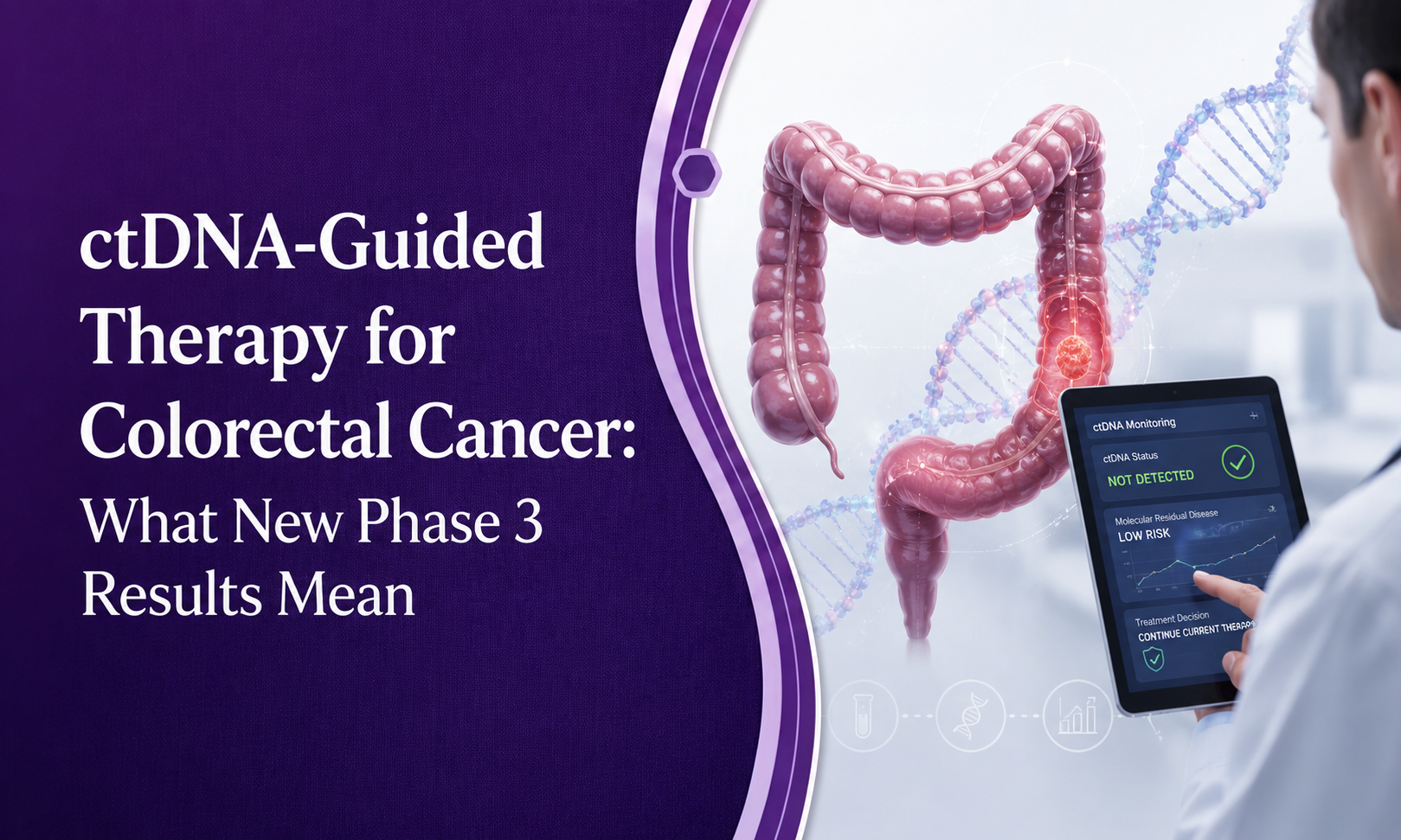
This is where ctDNA-guided therapy for colorectal cancer has become a major topic in cancer research. ctDNA stands for circulating tumor DNA.
It refers to small pieces of cancer DNA that can move through the bloodstream. A ctDNA blood test may help doctors detect signs of cancer activity before a tumor appears on a scan.
A new phase 3 trial called ALTAIR studied whether this blood-test approach could guide treatment after colorectal cancer surgery. The results brought both hope and caution. ctDNA helped identify patients with higher recurrence risk, but the treatment tested in the study did not clearly prove enough benefit for the full patient group.
What is ctDNA in Colorectal Cancer?
ctDNA means cancer-related DNA fragments found in the blood. Tumors can release these tiny DNA pieces into circulation.
After surgery, doctors expect cancer-related DNA to drop or disappear. If ctDNA appears later, it may suggest molecular residual disease.
Molecular residual disease means microscopic cancer may still remain in the body. It does not always mean a visible tumor has returned. Instead, it works like an early warning sign.
Doctors and researchers pay close attention to ctDNA because it may help answer important questions:
Is the patient at higher risk of recurrence?
Could cancer return before scans detect it?
Should follow-up become more careful?
Could a clinical trial make sense?
Can treatment become more personalized?
For patients, this can feel confusing. A scan may look normal, while a blood test raises concern. Both results can happen together because scans and ctDNA tests look for different signs.
Why ctDNA-Guided Therapy Matters
Traditional colorectal cancer follow-up often includes doctor visits, imaging, blood tests, colonoscopy planning, and symptom checks. These tools remain important. However, they may not catch microscopic diseases early.
ctDNA-guided therapy aims to use blood-test information to guide care. The idea sounds simple: if ctDNA shows cancer signals after surgery, doctors may consider earlier treatment instead of waiting for visible recurrence.
This approach could change cancer care in the future. It may help doctors avoid overtreatment in lower-risk patients and act sooner in higher-risk patients. Still, research must prove that acting on ctDNA results improves outcomes, not just predicts risk.
That difference matters. A test can show risk, but treatment must also show real benefit.
What the ALTAIR Trial Studied
The ALTAIR trial focused on patients with resected colorectal cancer. “Resected” means doctors removed the cancer through surgery. These patients had no visible disease on imaging, but they later tested positive for ctDNA.
Researchers tested a medicine called trifluridine/tipiracil, also known as FTD/TPI. This drug already has use in certain colorectal cancer settings. In this study, researchers wanted to know whether giving FTD/TPI earlier could delay cancer recurrence in ctDNA-positive patients.
The study compared two groups:
One group received FTD/TPI.
One group received a placebo.
Treatment lasted up to six months.
Researchers measured disease-free survival.
Patients had ctDNA positivity but no visible cancer on scans.
Disease-free survival means the length of time a patient lives without cancer recurrence or disease progression.
Main Results: Helpful Signal, But Not a Clear Win
The ALTAIR trial showed a numerical improvement. Patients who received FTD/TPI had a median disease-free survival of 9.30 months. Patients who received a placebo had a median disease-free survival of 5.55 months.
At first, that looks encouraging. However, the study did not meet its main goal because the difference did not reach statistical significance.
In simple terms, researchers could not confirm that FTD/TPI clearly improved disease-free survival for the whole study group.
This is why experts describe the results as mixed.
The study suggests that ctDNA can identify patients at higher risk after colorectal cancer surgery. However, it does not prove that FTD/TPI should become the automatic treatment choice for all ctDNA-positive patients.
Why the Results Feel Mixed
The results create an important conversation in cancer care. The trial did not fail to show that ctDNA matters. Instead, it showed that the next step after a positive ctDNA result remains uncertain.
Some findings looked promising. A subgroup of patients with resected stage IV disease appeared to benefit more from FTD/TPI.
However, subgroup results need caution because they do not always change standard care right away.
The main message is clear: ctDNA gives useful risk information, but doctors still need stronger evidence on which treatment works best after ctDNA turns positive.
Key takeaways include:
ctDNA can help detect higher recurrence risk.
FTD/TPI showed a numerical disease-free survival improvement.
The primary endpoint was not met.
The benefit looked less clear in stage I to III patients.
Stage IV subgroup findings need more study.
Side effects remain an important concern.
Safety Concerns Patients Should Understand
Cancer treatment decisions always require a balance between benefit and risk. FTD/TPI caused more serious blood-related side effects than placebo in the ALTAIR trial. These side effects included problems such as low white blood cell counts and low neutrophil counts.
That matters because treating earlier only makes sense when the benefit clearly outweighs the harm. If a patient has no visible cancer on scans, doctors must think carefully before starting a medicine that can cause significant side effects.
Patients should never start, stop, or request cancer medicine based only on a news headline or blood test result. A cancer specialist should review the full picture, including stage, prior treatment, scan results, ctDNA pattern, overall health, and personal risk level.
What This Means for Patients After Colorectal Cancer Surgery
For patients, the biggest message is not fear. The real message is awareness. ctDNA may help doctors watch cancer risk more closely after treatment. It may also help patients discuss clinical trials and personalized follow-up plans.
If a patient has a positive ctDNA result, the next step may include closer monitoring, repeat testing, imaging, oncology review, or trial discussion. It does not always mean immediate treatment with one specific drug.
Helpful questions to ask an oncologist include:
What does my ctDNA result mean for my cancer stage?
Do I need to repeat ctDNA testing?
How often should I get scans?
Does my result change my follow-up plan?
Are there clinical trials for ctDNA-positive colorectal cancer?
What treatment options fit my health history?
These questions can make a confusing result easier to understand.
Symptoms That Should Not Be Ignored
Even with advanced testing, symptoms still matter. Patients with a history of colorectal cancer should contact their doctor if they notice:
Ongoing abdominal pain
Unexplained weight loss
New bowel habit changes
Loss of appetite
Unusual fatigue
Persistent nausea or vomiting
These symptoms do not always mean cancer has returned. Still, they deserve medical attention, especially after a colorectal cancer diagnosis.
Final Takeaway
ctDNA-guided therapy for colorectal cancer represents an exciting step toward more personalized cancer care. The ALTAIR phase 3 trial shows that ctDNA can identify patients who may face a higher recurrence risk after surgery. However, the tested treatment, FTD/TPI, did not clearly improve disease-free survival for the full study group.
So, ctDNA works as a powerful warning tool, but it does not yet provide a complete treatment answer. Patients should view CTDNA results as part of a larger care plan, not as a standalone decision.
Colorectal cancer follow-up should stay personalized. The best plan depends on cancer stage, surgery results, previous treatment, ctDNA trends, imaging, symptoms, and oncology guidance.
Worried about colorectal cancer risk, screening, or follow-up care? Passion Health Advanced Primary Care can help you understand your symptoms, health history, and next steps for safer care.
FAQs
1. What is ctDNA in colorectal cancer?
ctDNA means small pieces of cancer DNA found in the blood. Doctors may use it to check for possible cancer activity after treatment.
2. Can ctDNA predict colorectal cancer recurrence?
ctDNA can help show a higher risk of recurrence, but it does not always confirm that cancer has returned.
3. What is ctDNA-guided therapy?
ctDNA-guided therapy uses blood test results to help guide follow-up care, monitoring, or treatment decisions after colorectal cancer surgery.
4. Did the new phase 3 trial prove clear benefit?
No. The ALTAIR trial showed some promising signs, but it did not meet its main goal in the full patient group.
5. Should patients ask their doctor about ctDNA testing?
Yes. Patients with a history of colorectal cancer can ask their oncologist if ctDNA testing fits their stage, treatment history, and follow-up plan.