
Crohn’s Disease Symptoms: Early Warning Signs You Should Never Ignore
Do you find yourself running to the bathroom multiple times a day? Does a gnawing, persistent pain in your lower abdomen follow you after every meal? Have you lost weight without trying, felt exhausted for weeks on end, or noticed blood in your stool that you keep dismissing as nothing?
If any of this sounds familiar, your body might be sending you an important message — and it deserves a physician’s attention.
Crohn’s disease is a chronic inflammatory bowel condition that affects millions of people worldwide, yet it often goes undiagnosed for months or even years. Why? Because its symptoms are so easily confused with stress, food intolerance, or a passing stomach bug.
At Passion Health Physician, we believe that knowledge is your first step toward better health. This guide will walk you through everything you need to know about Crohn’s disease symptoms.
What Exactly Is Crohn’s Disease?
Crohn’s disease is a long-term inflammatory condition that belongs to a group of disorders known as inflammatory bowel disease, or IBD. Unlike a short-term gut infection that clears up on its own, Crohn’s involves the immune system mistakenly attacking healthy tissue in the digestive tract.
This abnormal immune response triggers persistent inflammation that can affect any segment of the gastrointestinal system — from the mouth all the way to the rectum.
Most commonly, the inflammation targets the final section of the small intestine, called the terminal ileum, and the beginning of the large intestine. However, what makes Crohn’s particularly challenging is that it is unpredictable.
Inflammation can appear in patches, skipping areas of healthy tissue, and can penetrate all layers of the bowel wall rather than staying on the surface — a hallmark that distinguishes it from other bowel conditions.
The condition most often first appears in people between the ages of 15 and 40, though it can develop at any stage of life.
The Core Symptoms of Crohn’s Disease
One of the most important things to understand about Crohn’s disease symptoms is that they vary significantly from person to person. The location of inflammation, the severity of the disease, and individual differences all play a role. However, there are several symptoms that physicians look for consistently when evaluating a patient for Crohn’s.
Persistent Abdominal Pain and Cramping
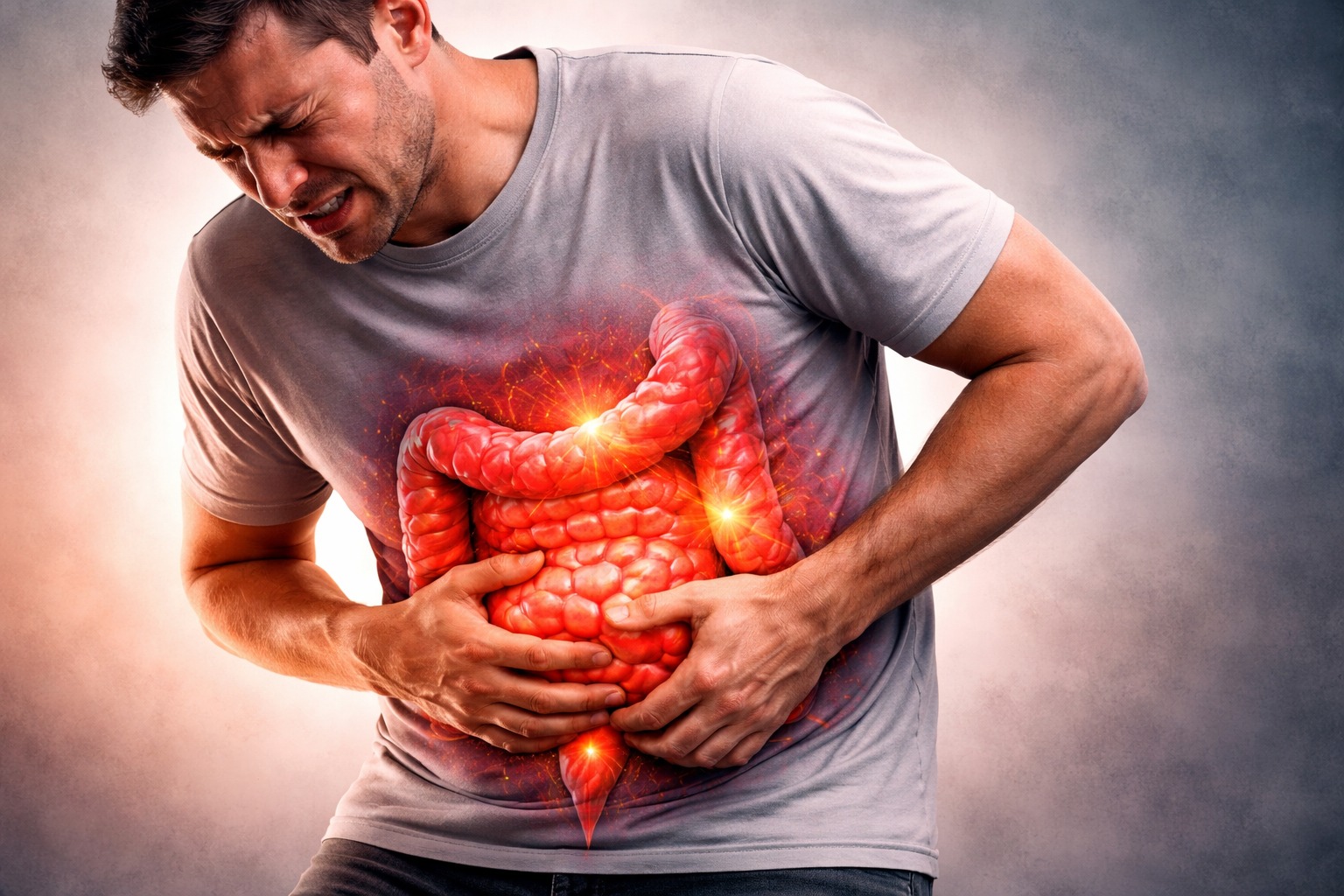
Pain is one of the most common and often most distressing symptoms of Crohn’s disease. It typically presents as cramping or aching in the lower right side of the abdomen, although it can occur anywhere across the belly. This pain frequently worsens after eating, as the digestive tract works to move food through inflamed sections of the intestine.
Chronic Diarrhea
Frequent, urgent, and sometimes severe diarrhea is one of the hallmark signs of active Crohn’s disease. Some people experience loose stools four to six times daily, while others may have more.
The diarrhea may contain mucus and, in more active disease, visible blood. Unlike a stomach bug, this pattern of bowel changes does not resolve within a week or two — it persists, recurs, and disrupts everyday life.
Unintended Weight Loss
When the intestines are inflamed, the body’s ability to absorb nutrients from food is significantly impaired. Combine this with reduced appetite — which many Crohn’s patients experience because eating triggers pain — and the result is often noticeable, unintended weight loss. This is not the kind of weight loss associated with a diet change; it is driven by your body’s inability to extract what it needs from the food you eat.
Fatigue That Does Not Improve with Rest
Deep, persistent fatigue is one of the most underreported yet debilitating symptoms of Crohn’s disease. This goes beyond simply feeling tired after a poor night’s sleep.
The combination of chronic inflammation, nutritional deficiencies, and anemia — which develops when intestinal bleeding leads to iron loss — drains the body of energy in a way that rest alone cannot fix.
Rectal Bleeding and Blood in the Stool
When inflamed sections of the intestine become ulcerated, they can bleed. This may show up as red blood visible in the toilet bowl or on toilet paper, or as darker, tarry stools if the bleeding is occurring higher up in the digestive tract.
Blood in the stool is never something to dismiss or delay investigating. It always warrants a conversation with your physician.
Fever and Night Sweats
During active phases of Crohn’s disease, especially during a flare, the body’s inflammatory response can produce a low-grade fever. Night sweats often accompany this, disrupting sleep and adding to the general exhaustion many patients already experience. A persistent low-grade fever in combination with digestive symptoms is a strong signal to seek medical evaluation promptly.
Mouth Ulcers
Because Crohn’s disease can technically affect any part of the gastrointestinal tract from the mouth downward, some patients develop recurring ulcers or sores inside the mouth. These are often dismissed as ordinary canker sores, but when they appear repeatedly alongside other digestive symptoms, they form an important piece of the diagnostic picture.
Symptoms Beyond the Gut: Extraintestinal Manifestations
What surprises many patients — and even delays some diagnoses — is that Crohn’s disease does not always limit its effects to the digestive system.
In a significant number of cases, the underlying inflammation reaches other areas of the body, producing symptoms that seem entirely unrelated to gut health.
Joint pain and swelling, particularly in the knees, ankles, and wrists, is one of the more common extraintestinal effects.
Some patients develop skin conditions, including a tender, red rash on the legs known as erythema nodosum, or deeper skin ulcers called pyoderma gangrenosum.
Eye inflammation — causing redness, pain, and light sensitivity — can also occur. Liver involvement, though less frequent, has been documented in Crohn’s patients as well.
Understanding Flares and Remission
Crohn’s disease does not follow a steady, predictable path. For most people, the condition cycles between two distinct phases.
During a flare-up, symptoms become active and often intense — pain, diarrhea, bleeding, and fatigue may all return or worsen simultaneously.
During remission, symptoms quiet down significantly, and some patients feel almost completely well.
The challenge is that flares can be triggered by a wide range of factors, and they are difficult to predict.
Common flare triggers include high psychological stress, certain foods (though these vary from person to person), infections, and — critically — stopping medication too soon because symptoms have improved.
What Causes Crohn’s Disease?
There is no single, definitive cause of Crohn’s disease, and this remains an active area of medical research.
What physicians understand is that the condition arises from a combination of factors coming together in a way that dysregulates the immune system’s response to the gut.
Genetics plays a meaningful role. If a parent, sibling, or close blood relative has Crohn’s disease or another inflammatory bowel condition, your risk is meaningfully elevated compared to the general population.
Stress does not cause Crohn’s disease, but it can act as a trigger for flares in people who already have the condition. This is a distinction worth understanding clearly — stress management matters for disease management, but stress itself is not the root cause.
How Is Crohn’s Disease Diagnosed?
Diagnosing Crohn’s disease requires more than a single test. Because its symptoms overlap with many other digestive conditions — including ulcerative colitis, irritable bowel syndrome, and infectious gastroenteritis — physicians take a comprehensive, layered approach to reach a confirmed diagnosis.
Your physician will begin with a thorough review of your symptoms, medical history, and family history.
• Blood tests to measure inflammatory markers like C-reactive protein (CRP) and erythrocyte sedimentation rate (ESR), as well as checking for anemia and ruling out infection
• Stool tests to identify blood, infection-causing organisms, or fecal calprotectin — a protein released by white blood cells during intestinal inflammation
• Colonoscopy, which allows the physician to directly visualize the lining of the colon and terminal ileum and take tissue biopsies for laboratory analysis — the most definitive diagnostic step
• CT or MRI scans to assess the extent of inflammation, detect narrowing of the intestine, or identify complications such as abscesses or fistulas
• Capsule endoscopy, where you swallow a small camera capsule that photographs the entire small intestine from within
Reaching a definitive diagnosis can sometimes take weeks or months, particularly in cases where symptoms are mild or inconsistent.
Living Well with Crohn’s Disease: What You Can Do
While Crohn’s disease is a lifelong condition, it is also a manageable one.
With the right medical care, many people with Crohn’s disease lead full, active, and productive lives. The key is a combination of appropriate medical treatment and informed lifestyle choices.
Medical Treatment
Treatment for Crohn’s disease is tailored to the individual based on the severity of symptoms, the location of inflammation, and the patient’s overall health profile.
Your physician may recommend anti-inflammatory medications, immune system suppressors, biologic therapies that target specific proteins driving inflammation, or a combination of these.
Diet and Nutrition
While no specific diet cures Crohn’s disease, what you eat has a genuine impact on how you feel. Many patients find that keeping a food diary helps identify personal trigger foods.
Common offenders include high-fiber raw vegetables during a flare, fatty or fried foods, dairy products in those who are lactose intolerant, and spicy foods.
Working with your physician or a registered dietitian to develop an eating plan that supports both nutrition and comfort is enormously beneficial.
Stress Management
Because stress can trigger flares, stress management is an essential part of disease management — not an optional extra. Regular physical activity (adapted to your energy levels), adequate sleep, mindfulness practices, and, where appropriate, support from a mental health professional, all contribute to better overall outcomes for people living with Crohn’s disease.
Regular Medical Follow-Up
Perhaps the most important thing you can do when living with Crohn’s disease is to stay in consistent contact with your physician. Routine check-ins, even during periods of remission, allow your doctor to monitor the disease, adjust treatment if needed, and catch complications early.
The Passion Health Physician Approach to Crohn’s Disease Care
At Passion Health Physician, we understand that receiving a diagnosis of a chronic condition can feel overwhelming.
Our approach is built on three principles: listening carefully to you as an individual, providing evidence-based guidance that reflects the latest in medical research, and standing beside you as a partner throughout your health journey.
We know that no two patients with Crohn’s disease are alike. Your symptoms, your lifestyle, your concerns, and your goals are unique to you.
Accurate diagnosis and advanced testing
Personalized treatment plans
Nutritional and lifestyle guidance
Long-term disease management support
We focus not just on treating symptoms but improving your overall health and quality of life.
Book an Appointment Today
If you are experiencing symptoms of Crohn’s disease, do not ignore them.
Early medical intervention can prevent complications and help you live a healthier life.
Book an appointment with Passion Health Physicians today and take the first step toward better digestive health.
Final Thoughts
Crohn’s disease symptoms can start small but lead to serious complications if untreated. Understanding early warning signs, seeking timely medical care, and following a structured treatment plan can make a significant difference.