
Key Takeaways
- Every adult should discuss getting an Lp(a) test at least once.
- A standard cholesterol panel usually does not include Lp(a).
- Genes largely determine Lp(a), and elevated levels often cause no symptoms.
- High Lp(a) can increase heart attack, stroke, and aortic valve disease risk.
- An Lp(a) level of 125 nmol/L or 50 mg/dL and above may enhance cardiovascular risk.
- High results call for a complete risk review and stronger control of modifiable factors.
A standard cholesterol panel can tell you about LDL, HDL, and triglycerides. However, it usually does not show your lipoprotein(a), or Lp(a), level. That matters because Lp(a) can add inherited cardiovascular risk even when other cholesterol numbers look reassuring.
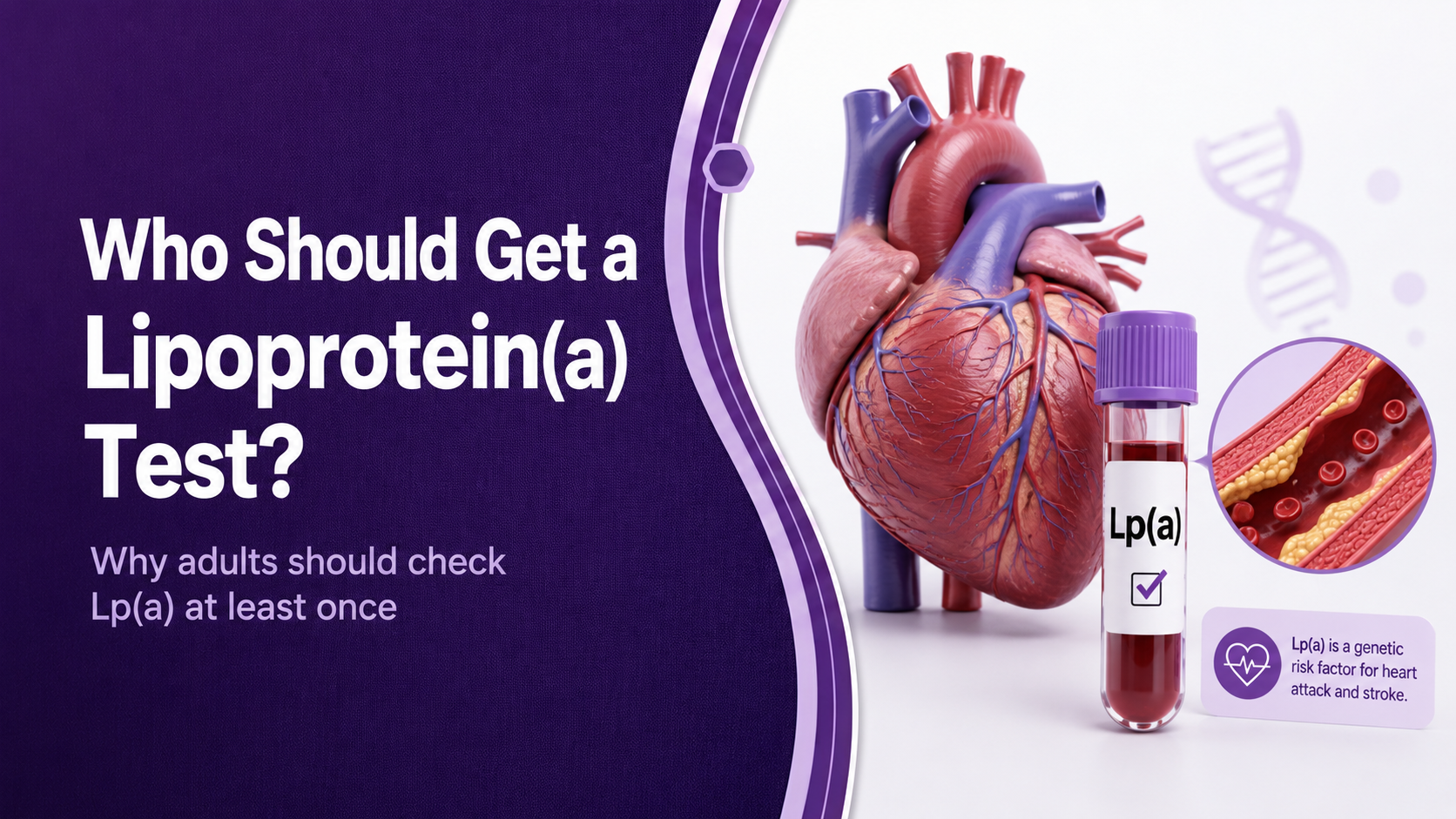
The 2026 ACC/AHA dyslipidemia guideline recommends that every adult get Lp(a) measured at least once. The test can uncover a largely inherited risk factor that often causes no symptoms.
What Is Lipoprotein (a)?
Lp(a) is a cholesterol-carrying particle in the blood. It resembles LDL but also contains a protein called apolipoprotein(a). Genes drive most variation in Lp(a), so healthy eating and exercise may improve overall heart health without substantially changing the Lp(a) number.
Higher Lp(a) can contribute to atherosclerotic cardiovascular disease and also relates to calcific aortic valve stenosis. Because levels often stay stable through adulthood, one measurement can provide useful long-term risk information.
Who Should Get a Lipoprotein(a) Test?
The simplest answer has changed: every adult should discuss getting Lp(a) checked at least once. Current ACC/AHA, National Lipid Association, and European guidance support at least one adult measurement.
Testing deserves even more attention when you have:
A parent, sibling, or child with high Lp(a)
A family history of early heart attack, stroke, or cardiovascular disease
Familial hypercholesterolemia or unusually high LDL cholesterol
Known coronary, carotid, or peripheral artery disease
Cardiovascular disease that seems out of proportion to traditional risk factors
A vascular event despite well-controlled LDL cholesterol
A clinician may also consider testing close relatives when one family member has markedly elevated Lp(a). This approach can help identify inherited cardiovascular risk earlier.
Why Can a Normal LDL Level Miss Part of the Picture?
LDL cholesterol remains a major cardiovascular risk factor, but LDL and Lp(a) do not measure the same thing. Someone can reach a favorable LDL level and still have high Lp(a).
High Lp(a) does not guarantee a heart attack or stroke. Instead, clinicians treat it as a risk-enhancing factor and consider it alongside age, blood pressure, diabetes, tobacco use, kidney health, LDL cholesterol, and family history.
Important: Lp(a) adds context to cardiovascular risk; it does not replace a complete risk assessment.
What Did the Large Midwest Study Find?
A 2025 retrospective study examined 419,812 adults ages 40 to 79 in a Midwestern healthcare system. Only 7,618 patients received an Lp(a) test.
7,618 ÷ 419,812 × 100 = about 1.8% tested |
Therefore:
100% − 1.8% = approximately 98.2% without a recorded Lp(a) test |
Among people without established ASCVD, only 1.4% underwent testing. Even among those who already had ASCVD, only 4.9% received the test.
The study cannot prove that testing prevents cardiovascular events. However, it highlights a large gap between guideline support for Lp(a) measurement and real-world testing.
How Do You Read an Lp(a) Result?
Laboratories may report Lp(a) in nmol/L or mg/dL. These units describe Lp(a) differently, so avoid using a fixed mathematical conversion between them.
The 2024 National Lipid Association update offers this practical framework:
Lp(a) Level | General Interpretation |
Below 75 nmol/L or below 30 mg/dL | Lower risk range |
75–124 nmol/L or 30–49 mg/dL | Intermediate range |
125 nmol/L or 50 mg/dL and above | High-risk range |
The 2026 ACC/AHA guideline identifies 125 nmol/L or 50 mg/dL and above as a cardiovascular risk-enhancing level. It also notes that levels around 250 nmol/L or 100 mg/dL associate with approximately twice the estimated ASCVD risk.
These numbers do not work like a simple pass-or-fail test. Cardiovascular risk rises across a continuum, so your clinician should interpret the result within your complete health picture.
Do You Need to Fast for an LP(a) Test?
An Lp(a) test requires a blood sample. Preparation can depend on the laboratory and whether your clinician orders other lipid tests at the same time.
Ask the clinic or laboratory whether you need to fast. Do not change medicines or supplements unless your healthcare professional advises it.
What Happens If Your Lp(a) Is High?
You cannot change the genes that strongly influence Lp(a), but you can address modifiable cardiovascular risks. A clinician may review LDL cholesterol, blood pressure, blood sugar, tobacco exposure, activity, nutrition, weight, kidney health, and family history.
The 2026 ACC/AHA guideline supports more intensive LDL-C lowering and risk-factor management when elevated Lp(a) increases cardiovascular risk. Treatment varies by person, so an Lp(a) result should start an individualized discussion.
Healthy habits still matter. Exercise, heart-supportive eating, adequate sleep, and avoiding tobacco can reduce other contributors to cardiovascular disease even when they do not substantially change Lp(a).
When Should You Talk With a Primary Care Provider?
Do not wait for symptoms to discuss cardiovascular prevention. High cholesterol and elevated Lp(a) can remain silent.
Bring up Lp(a) during a preventive visit if you have never had the test, especially if cardiovascular disease runs in your family. Your primary care provider can review your history, order appropriate labs, interpret the results, and decide whether additional risk assessment makes sense.
Take the Next Step for Your Heart Health
A single blood test can add information that a routine cholesterol panel may miss. If you have never checked Lp(a), a preventive visit offers a good opportunity to discuss testing.
Ask whether a lipoprotein(a) test should become part of your personalized heart health plan.
Book an appointment with Passion Health Advanced Primary Care to review your cholesterol, family history, blood pressure, diabetes risk, and other cardiovascular factors
Frequently Asked Questions
1. Does a regular cholesterol panel include Lp(a)?
Usually not. A clinician generally needs to order Lp(a) separately.
2. How often should adults get an Lp(a) test?
For many adults, one measurement may provide enough information because Lp(a) often stays stable. Some clinical situations may justify repeat testing.
3. Can I have high Lp(a) with normal LDL cholesterol?
Yes. Lp(a) can remain elevated even when LDL falls within a favorable range.
4. Can diet lower Lp(a)?
Diet may not substantially lower genetically driven Lp(a), but heart-healthy habits can reduce other cardiovascular risks.
5. Does high Lp(a) mean I will develop heart disease?
No. High Lp(a) increases cardiovascular risk, but it does not predict an event with certainty. Your overall risk profile matters.

About the Author
Dr. Anantha Chentha is a board-certified internal medicine physician with extensive experience in primary care and chronic disease management. He provides comprehensive, patient-centered care with a focus on prevention, accurate diagnosis, and long-term health management.
View Provider Profile →