
Target Heart Rate Zone Calculator
Estimate your workout heart rate zones using age, resting heart rate, gender, fitness level, and preferred calculation method.
Your Estimated Heart Rate Zones
| Zone | Intensity | Heart Rate Range | Best For |
|---|
Why Should You Check Your Heart Rate During Exercise?
A heart rate zone calculator for exercise can help you understand one important question: Is your workout helping your heart, or are you pushing too hard?
Many people judge exercise by sweat, tiredness, or calories on a fitness watch. However, your heart rate tells a deeper story. It shows how hard your heart works during walking, running, cycling, gym workouts, or cardio training.
The American Heart Association says a simple estimate for maximum heart rate is 220 minus age. It also explains that moderate-intensity exercise usually falls around 50% to 70% of maximum heart rate, while vigorous exercise often falls around 70% to 85%. These numbers work as general guides, not perfect rules.
That matters because exercise should build health, not create fear, dizziness, chest pressure, or burnout.
Not sure what exercise heart rate is safe for your body? Book an appointment with Passion Health Primary Care
What Is a Heart Rate Zone Calculator for Exercise?
A heart rate zone calculator for exercise estimates your target heart rate during physical activity. It divides your heart rate into zones, from light effort to maximum effort.
Each zone has a purpose. One zone helps with warm-up. Another supports endurance. Higher zones challenge performance, speed, and strength.
Most calculators start with your maximum heart rate. A common estimate is:
Maximum heart rate = 220 minus your age
For example, a 40-year-old adult may have an estimated maximum heart rate of about 180 beats per minute.
Then, the calculator uses percentages to create zones. These zones help you know whether your body works at a light, moderate, vigorous, or very hard level.
Still, a heart rate zone calculator for exercise gives an estimate only. It does not know your medical history, blood pressure, diabetes risk, heart symptoms, medications, sleep, stress, or hydration level.
Why Heart Rate Zones Matter During Exercise
Heart rate zones matter because guessing can lead to two common mistakes.
Some people exercise too lightly and never challenge their heart enough. Others push too hard, too soon, and feel exhausted, dizzy, or discouraged.
A heart rate zone calculator for exercise helps you train smarter. It can guide your pace during:
Walking
Running
Cycling
Swimming
Treadmill workouts
Elliptical workouts
Strength circuits
Cardio classes
Weight loss exercise plans
Additionally, heart rate zones help beginners avoid overtraining. Starting too fast can cause soreness, injury, shortness of breath, or fear of exercise. Therefore, many people do better when they begin in lower zones and slowly increase intensity.
Why Heart Rate Zones Matter More Than Guessing
Many people judge exercise by sweat. Some judge it by tiredness. Others follow a fitness watch without asking whether the number makes sense.
That can create a problem.
Your heart rate tells a more direct story about exercise intensity. If your heart rate stays too low, your workout may not challenge your cardiovascular system enough. If it climbs too high too quickly, the workout may place unnecessary stress on your body.
A heart rate zone calculator for exercise can help answer three important questions:
Is this workout too easy?
Is this workout improving fitness?
Is this workout too hard for my current health?
Heart rate zones also help beginners avoid a common mistake: starting too fast.
Mayo Clinic advises beginners to aim for the lower end of the target heart rate zone and build intensity slowly.
That advice matters, especially for adults who recently started walking, running, cycling, or gym training after a long break.
How Does a Heart Rate Zone Calculator for Exercise Work?
A heart rate zone calculator for exercise usually uses one of three methods.
The first method uses a percentage of maximum heart rate. This method works well for a simple estimate.
The second method uses heart rate reserve. This method includes resting heart rate, so it feels more personal.
The third method uses a threshold heart rate. Athletes and runners often use this method because it relates to performance effort.
For most patients, age and resting heart rate give a useful starting point.
A simple five-zone system looks like this:
Zone 1: Very light effort
Zone 2: Light to moderate effort
Zone 3: Moderate cardio challenge
Zone 4: Hard effort
Zone 5: Maximum effort
However, the best zone depends on your goal, fitness level, and health status.
Resting Heart Rate
This becomes more personalized when it uses resting heart rate.
This method often follows the heart rate reserve formula, also called the Karvonen method.
Heart rate reserve means:
Maximum heart rate minus resting heart rate
Cleveland Clinic explains that heart rate reserve uses both maximum heart rate and resting heart rate. It can help estimate the target heart rate more accurately than using only a percentage of maximum heart rate.
Here is a simple example.
A 45-year-old adult may have an estimated maximum heart rate near 175 to 177 bpm, depending on the formula.
If the resting heart rate is 70 bpm, the calculator has more personal data than age alone.
That extra number matters because resting heart rate often reflects fitness, stress, medications, sleep, and health status.
For primary care patients, this detail matters even more. High blood pressure, diabetes, thyroid problems, anemia, dehydration, anxiety, and certain medicines can change heart rate.
So, a heart rate zone may look “normal” online but still feel unsafe in real life.
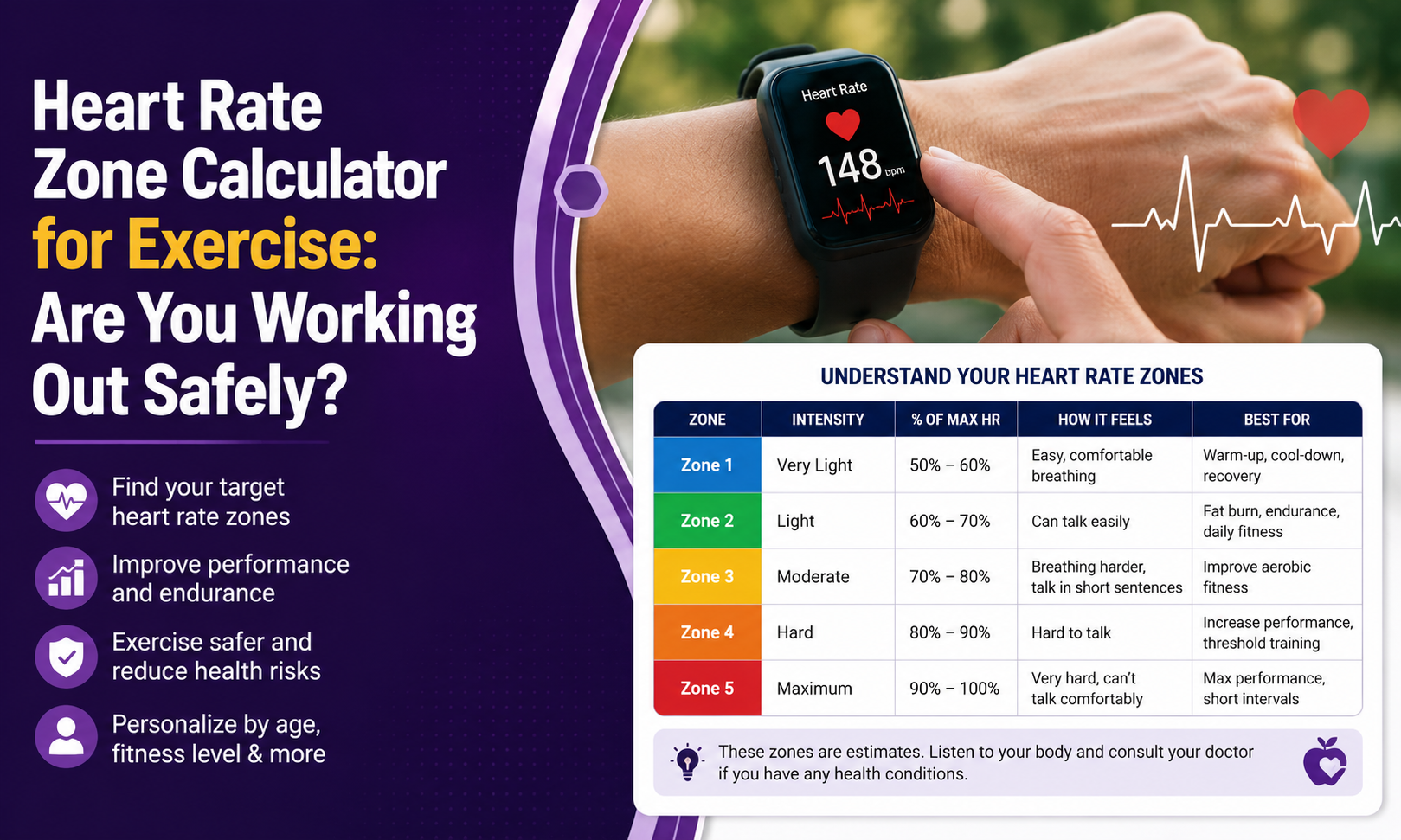
Heart Rate Zone Calculator for Exercise: 5 Zones Explained
Use this table inside your blog after the section “Heart Rate Zone Calculator for Exercise: 5 Zones Explained.” Heart rate zones usually use percentages of estimated maximum heart rate; the American Heart Association lists moderate exercise around 50%–70% and vigorous exercise around 70%–85% of maximum heart rate, while the Cleveland Clinic explains the common 5-zone structure.
Heart rate zone | Intensity level | % of Max heart rate | How it feels | Best for | Safety note |
Zone 1 | Very Light | 50-60% | Easy breathing, can talk comfortably | Warm-up, cool-down, recovery walks | Good starting zone for beginners |
Zone 2 | Light to Moderate | 60-70% | Breathing increases, can still speak | Endurance, fat use, steady cardio | Best zone for building consistency |
Zone 3 | Moderate | 70-80% | Breathing feels harder, shorter sentences | Cardio fitness, stamina, and workout progress | Avoid jumping here too fast |
Zone 4 | Hard | 80-90% | Talking becomes difficult | Performance training, intervals | Use caution if you have health risks |
Zone 5 | Maximum Effort | 90-100% | Very hard, talking feels almost impossible | Short bursts, advanced training | Avoid without medical clearance if you have heart symptoms |
Simple Exercise Intensity Chart
Mayo Clinic also recommends using how exercise feels, not only heart rate numbers, because symptoms and breathing matter during workouts
Exercise Level | Talk Test | Common Activities |
Light | You can talk and may sing | Slow walking, warm-up, gentle cycling |
Moderate | You can talk, but not sing | Brisk walking, steady cycling, water aerobics |
Vigerous | You can say only a word | Running, fast cycling, intense cardio class |
Very Hard | Talking feels very difficult | Sprint intervals, high intensity bursts |
Best Heart Rate Zone for Exercise Beginners
Beginners should not chase high numbers. Instead, start with control and consistency.
A heart rate zone calculator for exercise can help beginners stay in Zone 1 or Zone 2 during the first few weeks.
A simple beginner plan may include:
Start with 10 to 15 minutes of walking.
Keep breathing comfortably.
Check your heart rate halfway through.
Add 5 minutes after several successful sessions.
Increase speed only when your body feels ready.
Stop if you feel chest pain, faintness, or severe breathlessness.
Progress should feel steady, not scary.
When Is Your Exercise Heart Rate Too High?
Your heart rate should rise during exercise. However, symptoms matter more than the number.
Stop exercising and seek medical help if you notice:
Chest pain or chest pressure
Pain spreading to the arm, jaw, neck, or back
Severe shortness of breath
Fainting or near-fainting
Irregular or racing heartbeat
Cold sweat with weakness
Confusion or unusual dizziness
Symptoms that do not improve with rest
A heart rate zone calculator for exercise can guide training, but it cannot protect you from warning signs. Your body deserves attention.
Who Should Talk to a Doctor Before Intense Exercise?
Talk to a healthcare provider before increasing workout intensity if you have:
High blood pressure
Heart disease
Chest pain
Irregular heartbeat
History of stroke
Severe obesity
Dizziness during activity
Shortness of breath with mild effort
Heart-related medication use
Some medicines, such as beta-blockers, can lower the heart rate. As a result, your watch may not show the same response as someone who does not take those medicines.
Therefore, a heart rate zone calculator for exercise works best when you combine it with medical guidance.
Final Takeaway
A heart rate zone calculator for exercise helps you exercise with more awareness. It can show whether your workout sits in an easy, moderate, vigorous, or high-intensity range.
However, numbers do not tell the whole story. Your breathing, energy, symptoms, and medical history matter too.
Start low. Build slowly. Watch warning signs. Most importantly, choose exercise that helps your heart grow stronger without putting your health at risk.
Want a safe exercise plan based on your health history, blood pressure, medications, and fitness level? Book an appointment with Passion Health Primary Care →
FAQs
1. What is a heart rate zone calculator for exercise?
A heart rate zone calculator for exercise estimates your workout heart rate range based on age, resting heart rate, and fitness level.
2. Which heart rate zone is best for beginners?
Beginners usually do best in Zone 1 or Zone 2 because these zones feel easier, safer, and better for building consistency.
3. Is a high heart rate during exercise dangerous?
A higher heart rate can happen during exercise, but stop if you feel chest pain, dizziness, fainting, severe shortness of breath, or an irregular heartbeat.
4. Can medications affect exercise heart rate?
Yes. Some medicines, especially heart and blood pressure medicines, can change how your heart rate responds during exercise.
5. Should I ask a doctor before intense exercise
Yes, especially if you have high blood pressure, diabetes, heart disease, chest pain, dizziness, or shortness of breath during activity.