Why CPR Steps for Cardiac Arrest Emergency Matter Right Now
A cardiac arrest does not wait for preparation. It strikes suddenly, often in homes, workplaces, or public spaces. In those critical moments, CPR steps for cardiac arrest emergency can decide between life and death.
Every minute without CPR reduces survival chances by nearly 10%. That number should not just inform you—it should move you to act faster the next time someone collapses in front of you.
You do not need a medical degree to respond. You only need clarity, confidence, and the right steps. This guide breaks down CPR steps for cardiac arrest emergency in a simple, practical way so you can act without hesitation.
If you ever face an unresponsive person, this knowledge becomes your first line of defense.
And if you want personalized emergency preparedness guidance, Passion Health Primary Care can help you stay ready with preventive and urgent care support.
CPR Steps for Cardiac Arrest Emergency – What It Really Means
CPR steps for a cardiac arrest emergency refer to a structured set of actions that help maintain blood flow when the heart stops beating.
Cardiac arrest is not the same as a heart attack. A heart attack involves blocked blood flow. Cardiac arrest means the heart stops pumping altogether.
When this happens:
Oxygen stops reaching the brain
Consciousness fades within seconds
Breathing becomes abnormal or stops
CPR steps for cardiac arrest emergency help circulate oxygen until emergency services restore the heart rhythm.
You act as a temporary life-support system.
The Two Adult CPR Steps Methods – Choose Your Path
Most guides confuse you with too many options. Here is the simple truth. There are only two ways to perform adult CPR steps. Your choice depends on one thing: your training level.
Method One – Hands-Only Adult CPR Steps
Choose this method if:
You never took a CPR class
You took a class years ago and forgot the details
You feel unsure about giving mouth-to-mouth
Hands-only adult CPR steps work incredibly well. Studies show they double or triple survival rates compared to doing nothing. Here is the full sequence:
Check for unresponsiveness. Tap the shoulder hard. Shout, “Are you okay?” No response? Move to step two.
Call Emergency immediately. Or yell for someone else to call. Put the phone on speaker so the dispatcher can guide you.
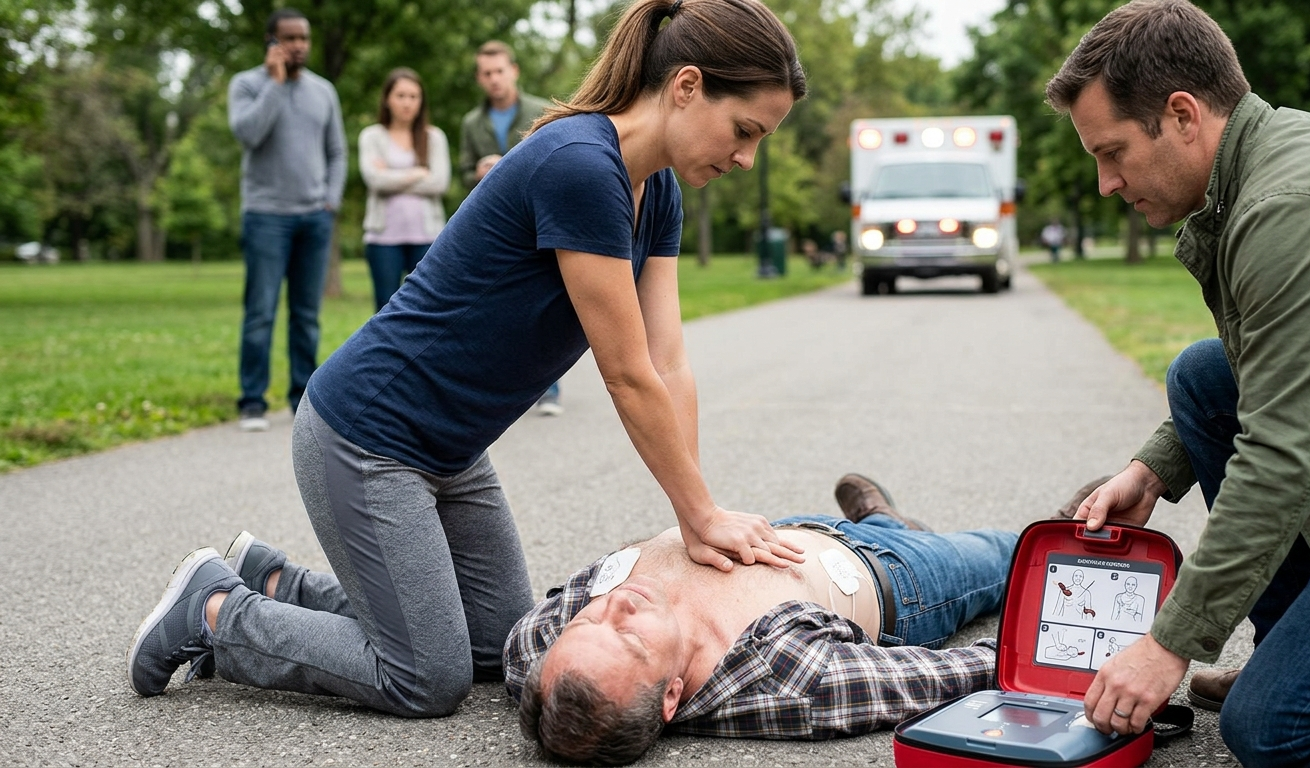
Push hard and fast on the chest center. Place one hand on top of the other. Lock your elbows. Push down at least two inches deep.
Keep a rhythm of 100 to 120 pushes per minute. Hum “Stayin’ Alive” by the Bee Gees. That song has the perfect beat.
Do not stop until help arrives or the person wakes up. Switch with another person every two minutes if possible.
No pulse check. No breaths. Just continuous chest compressions. That is all you need as a bystander.
Method Two – CPR With Breaths (30:2 Ratio)
Choose this method only if you have completed a certified CPR course within the last year. Otherwise, stick to hands-only. Incorrect breaths waste time and push air into the stomach instead of the lungs.
If you are trained, follow these adult CPR steps with breaths:
Check for pulse and breathing for no more than 10 seconds. Feel the neck artery. Watch the chest rise. Gasping is not normal breathing.
Start with 30 chest compressions. Use the same depth and rate as the hands-only method.
Open the airway. Tilt the head back and lift the chin.
Give two rescue breaths. Pinch the nose. Seal your mouth over theirs. Breathe just enough to see the chest rise. Each breath takes one second.
Repeat the 30:2 cycle. Keep going until advanced help arrives.
CPR Steps for Cardiac Arrest Emergency – Using an AED
An Automated External Defibrillator (AED) can restart the heart rhythm.
Turn on the AED
Follow voice instructions carefully.
Attach pads
Place pads on the bare chest as shown on the device.
Deliver shock if advised
Make sure no one touches the person during analysis or shock.
Then immediately resume CPR steps for a cardiac arrest emergency.
AED use significantly increases survival chances when combined with CPR.
Common Mistakes to Avoid
Many people hesitate or make errors during the CPR steps for a cardiac arrest emergency.
Avoid these:
Stopping compressions too often
Not pushing deep enough
Delaying CPR to “check too much.”
Forgetting to call emergency services
Speed and consistency matter more than perfection.
Why Immediate Action Saves Lives
The brain begins to suffer damage within 4–6 minutes without oxygen.
CPR steps for cardiac arrest emergency:
Keep oxygen flowing
Maintain circulation
Buy time for medical teams
Without action, survival drops rapidly.
With immediate CPR, survival rates can double or even triple in some cases.
This is not just a medical guideline—it is a real-life intervention that turns bystanders into lifesavers.
How Deep and How Fast? The Numbers You Must Memorize
Precision matters. Push too shallow, and you move little blood. Push too deep, and you break ribs (which is acceptable if it saves a life). Here are the exact numbers from Mayo Clinic for adult CPR steps:
Action | Target Number |
Compression depth | 2 to 2.4 inches (5–6 cm) |
Compression rate | 100 to 120 per minute |
Chest recoil (letting the chest fully rise) | 100% between each push |
Time off the chest for breaths (if used) | Less than 10 seconds |
Resuscitation cycle (if using breaths) | 30 compression: 2 breaths |
What Changes For Children And Infants?
This guide focuses on adult CPR steps for people aged 12 and older. But you may face a child or infant emergency. The core sequence stays the same. Only two numbers change.
For a child (1 to 12 years old):
Push to about 2 inches deep (use one or two hands depending on size)
Same rate of 100 to 120 per minute
For an infant (under 1 year old):
- Push to about 1.5 inches deep (use two fingers or the two-thumb encircling technique)
Same rate
Never use adult CPR steps on an infant without modification. The adult’s depth would crush their chest. Take a certified pediatric CPR class if you care for young children.
Emotional Reality You Must Understand: Cardiac arrest often happens to:
Family members
Colleagues
Strangers in public
The emotional shock can freeze people. But hesitation costs lives.
CPR steps for cardiac arrest emergencies give you structure when emotions feel overwhelming.
You do not need to feel ready. You only need to act.
When to Stop CPR
Continue CPR steps for cardiac arrest emergency until:
Emergency responders take over
The person starts breathing normally
You are physically unable to continue
An AED restores a normal heartbeat
Do not stop just because time passes. Survival often depends on persistence.
Prevention and Preparedness
While CPR steps for cardiac arrest emergencies save lives during a crisis, prevention matters equally.
Reduce risk by:
Regular heart checkups
Managing blood pressure
Avoiding smoking
Staying physically active
Recognizing early warning signs like chest pain or shortness of breath
At Passion Health Primary Care, preventive screenings and cardiovascular assessments help identify risks before emergencies occur.
Training Makes a Difference
Reading helps, but practice builds confidence.
CPR training classes teach:
Correct hand placement
Compression depth
AED usage
Emergency response coordination
Even one training session can dramatically improve your response during CPR steps for a cardiac arrest emergency.
Final Reality Check
You may never expect to perform CPR steps for a cardiac arrest emergency. But statistics show most cardiac arrests happen at home.
That means the person you save could be someone you love.
Your hands become the bridge between life and loss. Your response becomes the difference between tragedy and survival.
Act Before It Becomes Urgent
Do not wait for an emergency to learn what to do.
If you want to improve your health awareness, emergency readiness, or cardiovascular risk screening, schedule a visit with Passion Health Primary Care today.
Preparation today can save a life tomorrow—and that life may depend on you.