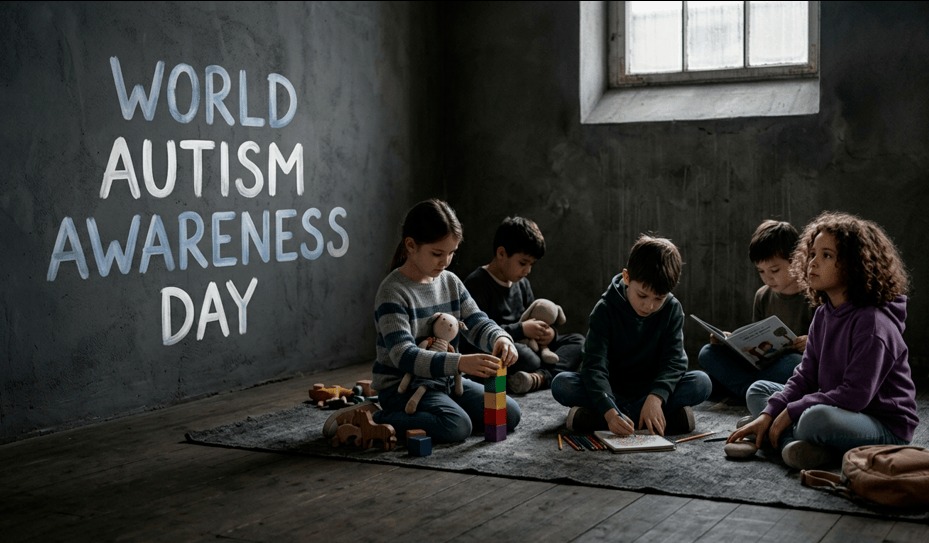
World Autism Awareness Day: Why Early Detection of Autism Can Change a Child’s Future
World Autism Awareness Day takes place every year on April 2nd. The goal is simple: help people understand autism spectrum disorder (ASD). On this day, families, schools, and organizations share stories and facts about autism. Many events also continue through April, which is known as Autism Awareness Month.
A Quick Look at the History
The United Nations created World Autism Awareness Day in 2008. The State of Qatar proposed the idea, and every UN member country supported it. Since then, April 2nd has become a global day for education, acceptance, and early action. The blue puzzle piece is now a well-known symbol. It represents the many different ways autism can look from one person to another.
What is Autism Spectrum Disorder?
Autism Spectrum Disorder (ASD) is a neurodevelopmental condition. In simple terms, a child’s brain processes information differently. We call it a “spectrum” because symptoms range from mild to severe. One child might be nonverbal with significant sensory issues.
Another child might speak well but struggle with social cues or rigid routines. Autism spectrum disorder symptoms usually appear before age three. This diagnosis does not define a child’s potential.
However, understanding the diagnosis early absolutely defines their path forward.
Early Signs of Autism Parents Should Never Ignore
Parents know their children better than anyone. Trust your gut. Do not dismiss odd behaviors as “just a phase.” Early intervention relies on recognizing red flags. Here are the early signs of autism in children that warrant a conversation with your doctor:
Delayed speech: No babbling by 12 months. No single words by 16 months. No two-word phrases by 24 months.
Lack of eye contact: Your child avoids looking into your eyes. They seem to look through you rather than at you.
Repetitive behaviors: Hand flapping, rocking, spinning, or obsessively lining up objects.
Social withdrawal: Your child does not respond to their name. They show little interest in other children or sharing enjoyment.
Loss of skills: A child who loses speech or social skills at any age needs immediate evaluation.
Why Early Diagnosis of Autism is Life-Changing
I tell every parent the same truth: The brain develops fastest in the first three years of life. This is your window of opportunity. Waiting until kindergarten to “see what happens” is a gamble with a child’s future.
The importance of early diagnosis of autism cannot be overstated. Here is why:
First, behavioral therapies are most effective when the brain is most plastic. Applied Behavior Analysis (ABA) and speech therapy rewire neural pathways. Second, early diagnosis reduces family stress.
Parents stop blaming themselves and start learning effective strategies. Third, early intervention directly improves school readiness. Children who receive therapy before age four are far more likely to transition into mainstream classrooms.
They develop communication skills. They build independence. They learn to navigate a world that does not always understand them.
I treated a patient named Maria. Her parents noticed her avoiding eye contact at 18 months. We screened her immediately. She started therapy at 20 months.
The Primary Care Role in Autism Detection
Many parents ask, “Why see my primary care doctor for a developmental issue?” The answer is simple. We see your child repeatedly. We track milestones at every well-child visit.
The primary care role in autism is to serve as the first line of detection. We do not replace specialists. We identify concerns and start the process.
During routine visits, I use standardized screening tools like the M-CHAT (Modified Checklist for Autism in Toddlers). I observe how your child interacts with me. Do they point at objects? Do they follow my gaze? Do they respond to a smile? If I see red flags, I do not wait. I refer you to a developmental pediatrician or a child psychologist immediately. We also rule out hearing problems or other medical issues that mimic autism symptoms.
Book a developmental screening at Passion Health Primary Care today if you have any concerns. Do not wait for a teacher or a relative to mention it.
What Parents Should Do Next
You suspect something is different. Now what? Follow these steps immediately:
Schedule a visit with your primary care provider. Tell the scheduler you have developmental concerns.
Complete a developmental screening questionnaire before your appointment.
Bring specific examples to your visit. Write down behaviors that worry you.
Request a referral to a specialist if your doctor agrees that further evaluation is needed.
What should you expect during screening? The process takes about 15 minutes. Your doctor will ask about social, emotional, and language milestones.
We will observe your child’s behavior. Most importantly, we will give you a clear answer: Watchful waiting, immediate therapy, or further testing. Do not delay. Every month you wait is a month of lost progress.
Breaking Autism Myths
Misinformation spreads quickly. As a physician, I must correct dangerous myths directly. Autism is not caused by parenting. The “refrigerator mother” theory from the 1950s is false and harmful. Autism is a biological condition with strong genetic links.
Let me also address the vaccine myth directly. Vaccines do not cause autism. Multiple large-scale studies involving millions of children have proven this conclusively.
The original study claiming a link was fraudulent and retracted. Protecting your child from measles, mumps, and rubella is critical. Avoiding vaccines only puts your child at risk for deadly diseases.
Finally, children with autism can thrive. They can go to college. They can hold jobs. They can form loving relationships. Autism is not a tragedy. Lack of support is the real tragedy.
Why This Day Matters
Too many people still misunderstand autism. Some believe old myths. Others do not recognize early signs. World Autism Awareness Day helps break down these barriers. When more people understand autism, communities become more inclusive. Children and adults with autism get better support at school, at work, and in daily life.
Simple Ways You Can Get Involved
You do not need to plan a large event to make a difference. Here are easy, meaningful actions:
Wear blue – Blue is the official color for autism awareness. A simple shirt or ribbon starts conversations.
Light it up blue – Homes, landmarks, and buildings glow blue on April 2nd. Check your local community events.
Join a local event – Look for walks, educational talks, or fundraising runs near you.
Learn one new fact – Read a short article or watch a video about autism. Then share what you learned with a friend.
Support a local organization – Find a group near you that provides therapy, support groups, or resources for autistic individuals.
Conclusion
Early detection of autism changes a child’s future. That is not a slogan. That is a medical fact. World Autism Awareness Day gives us a global platform.
But your child’s development does not follow a calendar. If you see delays in speech, eye contact, or social interaction, trust your instincts. The window for neuroplasticity is wide open right now.
At Passion Health Primary Care, we take developmental screening seriously. We listen to parents. We move quickly. And we never dismiss concerns as “wait and see.”
Schedule an appointment with Passion Health Primary Care to discuss your child’s development. One conversation can change everything. Do not wait for another World Autism Awareness Day to pass by. Act today. Your child’s future depends on it.