Key Takeaways
- Canker sores and cold sores are separate conditions.
- Most minor canker sores heal within two weeks.
- Gentle brushing and softer foods may ease discomfort.
- Track recurring sores, possible triggers, and other symptoms.
- Recurring canker sores do not always indicate a nutrient deficiency.
- Seek care for persistent, worsening, or disruptive mouth sores.
A small sore inside your mouth can make every sip, bite, or conversation uncomfortable. However, the right next step depends on how long it lasts, how often it returns, and whether other symptoms appear.
Understanding canker sore causes and treatment can help you manage discomfort and recognize when home care needs support.
What Is a Canker Sore?
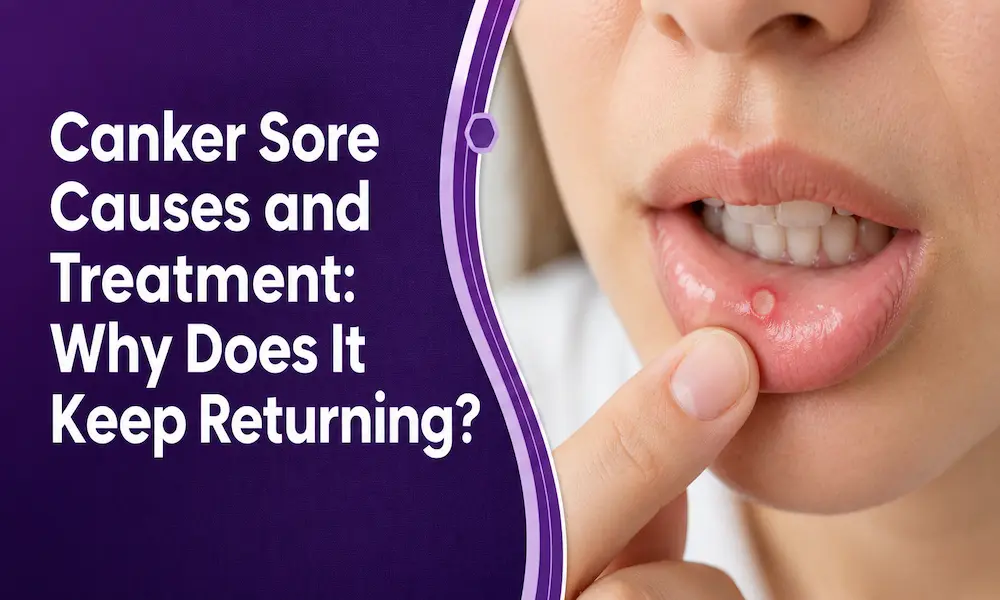
A canker sore is a shallow ulcer inside your mouth. It often has a white or yellow center with a red border. You may notice one inside your cheek, under your tongue, or along your inner lip.
Unlike cold sores, canker sores do not spread between people. Also, most minor sores heal within one to two weeks. Larger ulcers can take longer and may leave scars. [clevelandclinic]
Although people sometimes call every mouth lesion a canker sore, several conditions can cause mouth ulcers. Therefore, avoid assuming that an unfamiliar or persistent sore needs only home treatment.
What Causes Canker Sores?
Doctors do not know one exact cause. Instead, several factors may contribute to an outbreak.
Common triggers include cheek bites, rough brushing, dental appliance irritation, stress, and hormonal changes. Additionally, some people notice sores after certain foods or toothpaste containing sodium lauryl sulfate.
Nutritional deficiencies, including low iron, folate, or vitamin B12, may contribute in some cases. However, a mouth sore alone does not prove that you lack a nutrient.
When discussing canker sore causes and treatment, your clinician considers your overall health rather than focusing on one possible trigger.
Canker Sore or Cold Sore? Why the Difference Matters
Both conditions can hurt, but they require different guidance.
Feature | Canker sore | Cold sore |
Typical location | Inside the mouth | On or around the lips |
Appearance | Shallow white or yellow ulcer | Fluid-filled blister or blister cluster |
Cause | Often unclear; several triggers may contribute. | Herpes simplex virus |
Contagious? | No | Yes. |
Consequently, avoid choosing treatment based only on the word “sore.” A clinician can examine an uncertain lesion and explain the difference.
When Should You Visit Passion Health for a Mouth Sore?
Contact a primary care clinician or dentist if a sore:
Lasts longer than two weeks.
Becomes unusually large or painful.
Keeps returning.
Makes eating or drinking difficult.
Appears alongside fever or other symptoms.
Additionally, seek prompt assessment if symptoms worsen despite home care. Do not keep extending self-treatment while the sore changes or fails to improve. [medlineplus.gov]
For North Texas residents, a primary care appointment offers an opportunity to discuss both the mouth sore and any broader health concerns.
What Can a Primary Care Doctor Check During Your Visit?
First, your clinician examines the sore and asks when it started. Next, they review previous episodes, current medicines, dental irritation, and other symptoms.
For example, mention whether you recently changed toothpaste, started medication, or noticed sores after particular foods.
A typical canker sore usually does not require laboratory testing. However, severe, persistent, or frequent ulcers may prompt further investigation.
A personalized discussion of canker sore causes and treatment helps your clinician decide whether you need symptom relief, testing, or another evaluation.
Canker Sore Treatment: Home Care and Medical Options
Treatment aims to reduce discomfort and support healing. However, no remedy reliably removes every canker sore overnight.
Gentle Home Care to Ease Discomfort
Choose soft foods and avoid spicy, acidic, salty, or crunchy items that sting. Also, let hot meals cool before eating.
For a gentle rinse, dissolve half a teaspoon of salt in a glass of warm water. Swish the solution around your mouth, then spit it out. Do not swallow it.
Meanwhile, continue brushing gently with a soft toothbrush. These practical canker sore remedies can make recovery more comfortable.
When Topical Products or Prescription Rinses May Help
A pharmacist, doctor, or dentist can help you choose a suitable oral product. Depending on your symptoms, a clinician may recommend a topical medicine or prescription rinse.
For instance, certain corticosteroid preparations reduce inflammation. However, oral steroids generally do not serve as the first treatment choice because they can cause significant side effects.
Discuss canker sore causes and treatment before trying stronger medicines, especially when the diagnosis remains unclear.
Recurring Canker Sores: Could There Be an Underlying Cause?
Recurring canker sores do not automatically indicate a serious illness. Nevertheless, their pattern can help guide assessment.
Tell your clinician how often they appear, whether they fully heal between episodes, and what else happens around the same time.
Sometimes, deficiencies or conditions such as celiac disease and inflammatory bowel disease accompany recurrent ulcers. Therefore, mention digestive symptoms, dietary restrictions, or other ongoing concerns.
Your clinician can decide whether those details justify testing. Avoid starting high-dose supplements solely because a sore returns.
When Might You Need a Specialist?
A dentist can check whether a sharp tooth, denture, filling, or orthodontic appliance repeatedly rubs the same area.
Meanwhile, a primary care clinician can assess associated symptoms and broader medical concerns. These roles often complement each other.
If an ulcer persists or looks unusual, your clinician may recommend specialist assessment or a biopsy to clarify the cause. Further evaluation does not automatically mean cancer; it helps establish an accurate diagnosis.
How Can You Reduce Future Canker Sore Flare-Ups?
Start by tracking possible triggers rather than removing many foods at once. For example, record when a sore appears and any recent mouth injury or product change.
Also, use gentle brushing techniques and maintain regular dental visits. If a dental appliance rubs, ask your dentist about an adjustment.
Consider discussing toothpaste without sodium lauryl sulfate. However, remember that prevention measures cannot stop every episode.
For recurring symptoms, revisit canker sore causes and treatment with your clinician instead of repeatedly changing remedies.
Questions to Discuss at Your Passion Health Appointment
Bring a short symptom timeline and your medication list. Then ask:
Does this look like a canker sore?
Could my medicines or dental irritation contribute?
Do my symptoms suggest a need for testing?
Which treatment may help my discomfort?
When should I return if it does not improve?
Additionally, explain how pain affects meals, sleep, or daily activities. Those details help communicate what matters most to you.
Discuss Persistent Mouth Sores With Passion Health
Passion Health offers primary care across North Texas, including Frisco, Irving, Plano, Prosper, Aubrey, Flower Mound, McKinney, Ennis, Kaufman, and Kemp/Seven Points. Choose a convenient location when requesting your appointment.[Passion Health Advanced Primary Care]
Final Takeaway: Give Persistent Mouth Sores a Clear Next Step
Understanding canker sore causes and treatment starts with recognizing symptoms and knowing when to ask for help. You do not need to keep guessing about a sore that repeatedly interrupts your day.
Schedule an appointment with Passion Health to discuss persistent or recurring mouth sores and your next steps.
Mouth sores keep returning?
Schedule an evaluation at Passion Health Advanced Primary Care to discuss possible causes and receive personalized next steps.
Frequently Asked Questions
1. Can a primary care doctor assess canker sores?
Yes. A primary care clinician can examine mouth sores, review symptoms, and decide whether testing or referral would help.
2. Are canker sores contagious?
No. Canker sores do not spread through kissing or shared utensils. However, cold sores can spread between people.
3. How long do minor canker sores last?
Most heal within one to two weeks. Arrange an assessment if a sore persists beyond two weeks or worsens.
4. Do recurring canker sores always mean a vitamin deficiency?
No. Several factors can contribute. Your clinician can assess whether your history suggests a need for nutrient testing.
5. When should I see a dentist instead of a primary care doctor?
Start with a dentist for an obvious dental irritation. Otherwise, either professional can assess a persistent sore and guide further care.

About the Author
Dr. Anantha Chentha is a board-certified internal medicine physician with extensive experience in primary care and chronic disease management. He provides comprehensive, patient-centered care with a focus on prevention, accurate diagnosis, and long-term health management.
View Provider Profile →