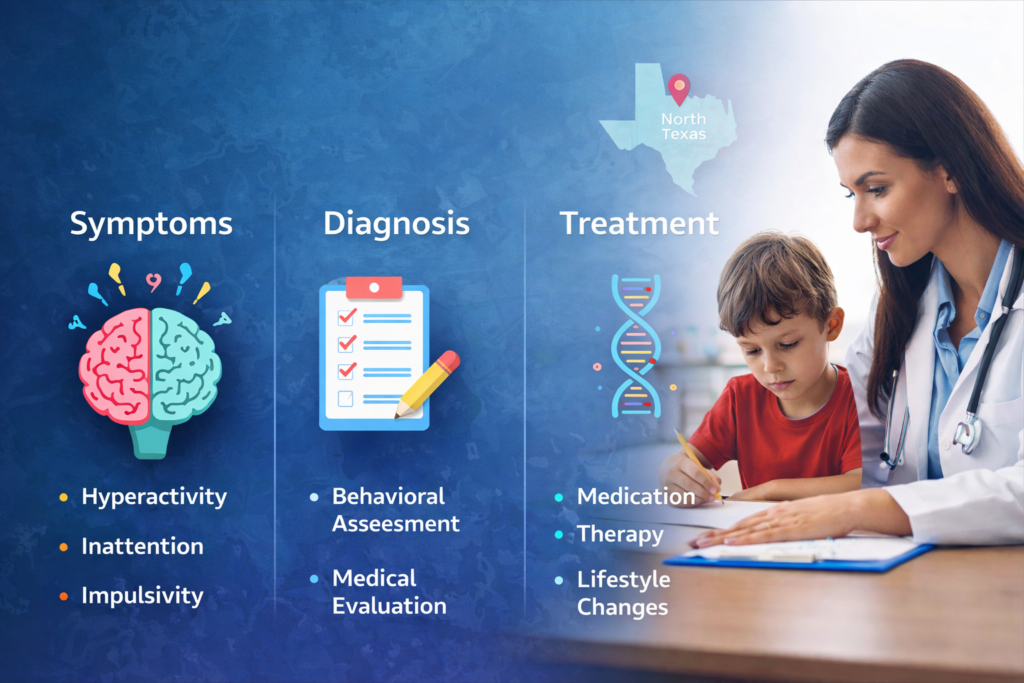
Attention-deficit/hyperactivity disorder (ADHD) involves differences in attention, activity level, and impulse control. It is a neurodevelopmental condition that affects executive functions such as planning, focus, and emotional regulation.
At Passion Health Primary Care, we evaluate and treat ADHD in children and adults across North Texas. We take a whole-person approach that combines clinical history, rating scales, and the checks needed to rule out other conditions.
What Is ADHD? (It’s Not Laziness)
Key takeaways
- ADHD is a neurodevelopmental condition that affects attention, activity level, and impulse control, and it can continue into adulthood.
- A thorough evaluation usually combines a clinical interview, validated rating scales, and checks for conditions that can mimic ADHD.
- No single test diagnoses ADHD on its own, including brain-activity assessments, which should support clinical judgment.
- Treatment often combines medication, when appropriate, with skills coaching, sleep habits, and school or workplace accommodations.
- Medication doses are adjusted gradually, with heart rate, blood pressure, and side effects monitored over time.
On this page
ADHD involves differences in how the brain uses chemical messengers such as dopamine and norepinephrine. It affects executive functioning, which can include:
Activation: Getting started on tasks (avoiding procrastination).
Focus: Shifting attention when needed (not just “zoning out”).
Effort: Sustaining motivation for boring tasks.
Emotion: Managing frustration and rejection sensitivity.
Memory: Utilizing working memory (holding info in your head).
The Reality: People with ADHD are often highly creative, energetic, and empathetic. The challenge is that their brains struggle to organize these strengths in traditional school or work environments.
The Three Types of ADHD
Diagnosis looks at patterns of attention and hyperactivity-impulsivity, not hyperactivity alone. Clinicians describe three presentations:
Predominantly Inattentive Presentation
Sometimes called “quiet ADHD,” this presentation can be missed, especially in girls and adults. Signs can include:
Signs: “Internal” distractibility, chronic time-blindness, losing keys/phones, and difficulty following long conversations.
Predominantly Hyperactive-Impulsive Presentation
In children, this looks like running or climbing. In adults, it often shifts to mental restlessness, interrupting others, or an inability to “shut off” their brain at night.
Combined Presentation
This presentation combines focus difficulties with impulsive energy.
The Passion Health Diagnosis Pathway
We believe diagnosis should be transparent and thorough. We do not rely on a single short conversation.
- Clinical interview: We review developmental history, sleep patterns, and daily life.
- Validated rating scales: We use evidence-based tools, such as the Vanderbilt or ASRS, to measure symptom severity.
- Rule-outs: We check for conditions that can mimic ADHD, such as sleep apnea, anxiety, and thyroid problems, and order labs when needed.
- Objective testing: When clinically appropriate, we may use BrainView, a brain-activity assessment that can add information to the evaluation.
The BrainView Assessment
At Passion Health, we may add BrainView, a brain-activity assessment, to the evaluation. It is one tool among several and does not diagnose ADHD on its own.
How BrainView Fits Into the Evaluation
Many evaluation tools rely on self-report. BrainView adds brain-activity measures that can support, but not replace, clinical judgment.
- Theta/beta ratio: Some studies have linked a higher ratio of slow (theta) to fast (beta) brain waves with ADHD, but this measure alone does not diagnose ADHD.
- Reaction time: The assessment measures response speed and consistency, which can show patterns of inattention during tasks.
- Context: Results are interpreted alongside your history and rating scales, because stress, anxiety, and poor sleep can also affect attention.
What to Expect
- Comfortable: You wear a cap with sensors. No needles are used.
- Duration: The test takes about 30–45 minutes at our office.
- Report: You may receive a visual summary of your results to review with your clinician.
Need care for this?
A Passion Health clinician can see you in person or online.

In person
Request an in-person visit at any Passion Health location to talk about focus, attention, or daily functioning concerns.
Choose your clinic and clinician across North Texas
Book an appointment in person at Passion Health clinics
Online
Answer a few questions online to find the right next step, whether that is a visit, lab work, or a referral. For non-emergency questions, you can get care online through Passion Health Online Care.
Adults 18 and older in Texas · Texas-licensed clinicians
Get the right care in a few steps
Blood work
Lab work may be ordered to check for conditions that can look like ADHD, based on your clinician’s judgment.
Essential Blood Work · $59
Get Passion Health Blood WorkMultimodal Treatment: A Whole-Person Approach
Medication alone does not teach skills. While medication can be a powerful tool, effective treatment often includes a multimodal approach.
Precision Medication Management
If stimulants (such as methylphenidate or amphetamines) or non-stimulants are needed, we monitor heart rate and blood pressure to help find the right dose, with the goal of maximum benefit and fewer side effects.
Lifestyle & Skills
- Nutrition: We discuss how eating patterns, including protein intake, may affect energy and focus.
- Sleep: We address sleep habits, because poor sleep can worsen attention.
- Executive function coaching: Strategies for using planners, digital calendars, and body-doubling techniques to get work done.
Support for Work & School (North Texas Resources)
Navigating the system can be difficult. We can help patients prepare documentation for school or workplace accommodations.
- Students: We can provide documentation to support 504 Plans or IEPs. Accommodations may include extra time on tests or a quiet testing room.
- Professionals: We can help with letters requesting reasonable accommodations at work, such as noise-canceling headphones, flexible start times, or written instructions.
Final Thoughts
ADHD is a lifelong condition, but it does not have to limit you. With a thorough evaluation and a plan built around your needs, many people find better focus and daily function.
Locations: Frisco, Plano, Seven Points, Aubrey
Frequently Asked Questions
Is it too late to get diagnosed as an adult?
It is never too late to be evaluated. Adults of any age can seek an assessment, and a diagnosis can help explain long-standing challenges.
Will medication change my personality?
It should not change who you are. The right dose should help you feel more focused and more like yourself. If you feel flat or robotic, tell your clinician so the dose can be adjusted.
Do you offer telehealth?
Some follow-up visits may be available by telehealth after an initial in-person visit, depending on your needs and medications. Our team can confirm which options apply to you.