The Complete Guide to ADHD: Symptoms, Diagnosis, and Advanced Treatment in North Texas
Attention-Deficit/Hyperactivity Disorder (ADHD) is not just about “trouble sitting still.” It is a complex neurodevelopmental condition that affects the brain’s “management system”—the executive functions that handle planning, focus, and emotional regulation.
At Passion Health Primary Care, we view ADHD through a neurodiversity-affirming lens. Whether you are a parent in Frisco worried about your child’s grades, or a professional in Plano struggling with burnout, our goal isn’t just to “fix” symptoms. It is to use advanced diagnostics—like BrainView—to help you understand your brain’s unique wiring and thrive.
1. What Is ADHD? (It’s Not Laziness)
ADHD is a biological difference in how the brain processes dopamine and norepinephrine. It affects Executive Functioning, which includes:
Activation: Getting started on tasks (avoiding procrastination).
Focus: Shifting attention when needed (not just “zoning out”).
Effort: Sustaining motivation for boring tasks.
Emotion: Managing frustration and rejection sensitivity.
Memory: Utilizing working memory (holding info in your head).
The Reality: People with ADHD are often highly creative, energetic, and empathetic. The challenge is that their brains struggle to organize these strengths in traditional school or work environments.
2. The Three Types of ADHD (2026 Classification)
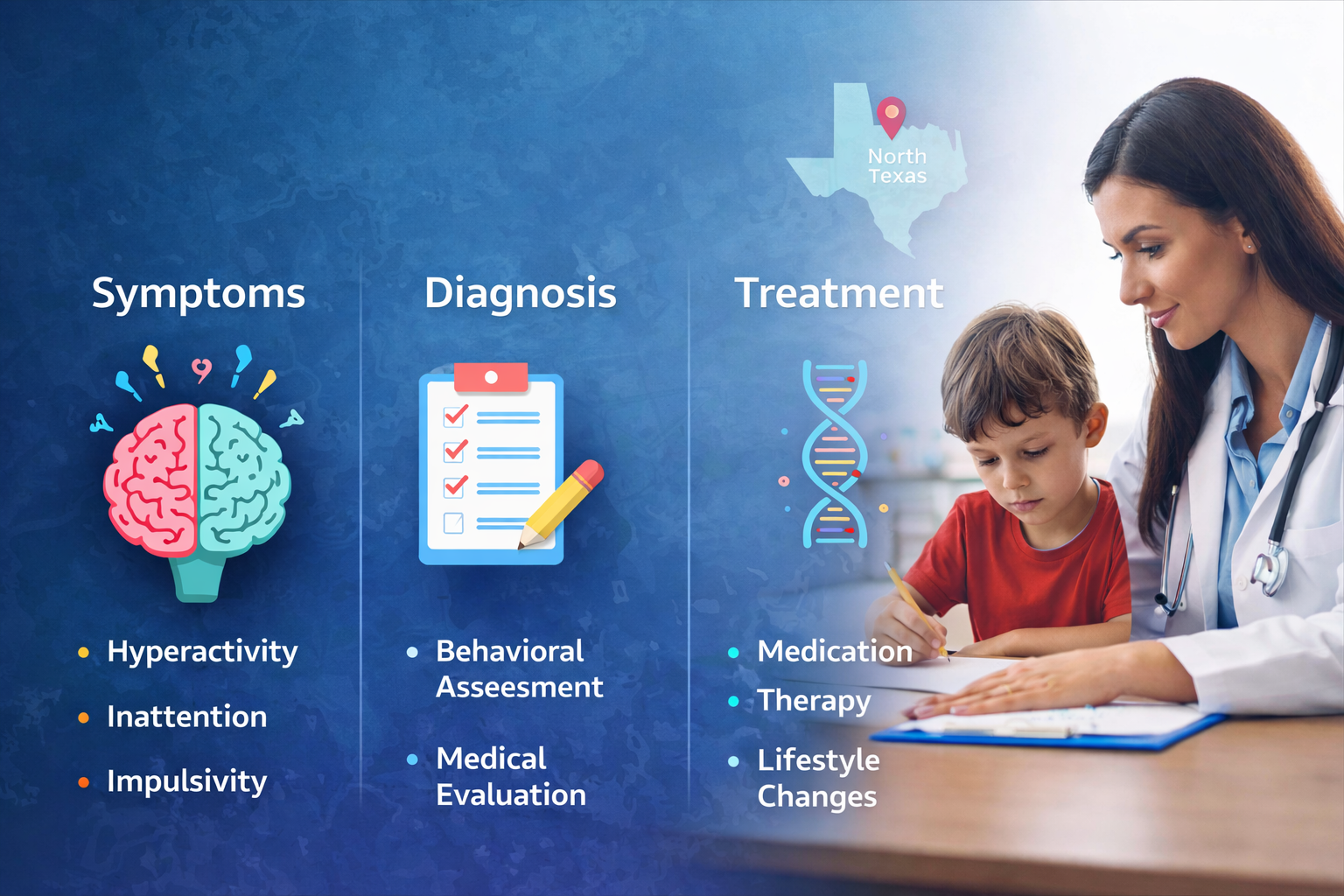
Medical professionals no longer look for just “hyperactivity.” Diagnosis is now based on three specific presentations:
A. Predominantly Inattentive Presentation
Often called “Quiet ADHD,” this is frequently missed in girls and adults.
Signs: “Internal” distractibility, chronic time-blindness, losing keys/phones, and difficulty following long conversations.
B. Predominantly Hyperactive-Impulsive Presentation
In children, this looks like running or climbing. In adults, it often shifts to mental restlessness, interrupting others, or an inability to “shut off” their brain at night.
C. Combined Presentation
The most frequent diagnosis we see at our clinics, involving a mix of focus struggles and impulsive energy.
3. The Passion Health Diagnosis Pathway
We believe diagnosis should be transparent and thorough. We do not rely on a single 5-minute conversation.
Clinical Interview: We review your developmental history, sleep patterns, and lifestyle.
Validated Rating Scales: We use evidence-based tools (like the Vanderbilt or ASRS) to measure symptom severity.
Rule-Outs: We screen for “ADHD Mimics.” Is it ADHD, or is it Sleep Apnea? Is it anxiety or a Thyroid imbalance? We check it all.
Objective Testing: This is where we differ from most clinics. We use BrainView technology.
4. Advanced Diagnostics: The BrainView NeuralScan
At Passion Health, we move beyond subjective checklists. We utilize the BrainView NeuralScan, a cutting-edge medical device that measures biological brain function.
How BrainView Changes the Diagnosis
Standard tests rely on you telling us how you feel. BrainView shows us how your brain works.
The Theta/Beta Ratio: This is an FDA-cleared biomarker. ADHD brains often show high “Theta” (daydreaming) waves and low “Beta” (focus) waves during tasks. BrainView detects this specific imbalance.
Reaction Time Analysis: It measures milliseconds of delay in processing speed, identifying “micro-lapses” in attention that are invisible to the naked eye.
Objective Certainty: This helps us distinguish between a brain that is truly ADHD versus one that is unfocused due to stress, anxiety, or lack of sleep.
What to Expect
Painless: You wear a comfortable cap with sensors (similar to a swim cap). No needles.
Fast: The test takes about 30–45 minutes in our office.
Visual: You receive a color-coded “Brain Map” that explains your cognitive strengths and weaknesses.
5. Multimodal Treatment: A Whole-Person Approach
Pills are not skills. While medication is a powerful tool, effective treatment requires a “multimodal” approach.
Precision Medication Management
If stimulants (like Methylphenidate or Amphetamines) or non-stimulants are needed, we monitor heart rate and blood pressure closely to find the “Goldilocks” dose—maximum benefit with minimum side effects.
Lifestyle & Skills
Nutritional Psychiatry: We explore how protein intake and gut health influence dopamine production.
Sleep Hygiene: Treating “revenge bedtime procrastination” to restore brain function.
Executive Function Coaching: Strategies for using planners, digital calendars, and body-doubling techniques to get work done.
6. Support for Work & School (North Texas Resources)
Navigating the system can be hard. We help our patients secure the legal protections they deserve.
For Students: We assist with documentation for 504 Plans or IEPs in local districts (like Frisco ISD, Plano ISD, and Denton ISD), securing accommodations like extra time on tests or quiet testing rooms.
For Professionals: We help with letters for Reasonable Accommodations at work, such as noise-canceling headphones, flexible start times, or written vs. verbal instructions.
7. Frequently Asked Questions (FAQ)
Q: Is it too late to get diagnosed as an adult? A: Never. Many patients diagnosed in their 30s, 40s, or 50s describe it as a “missing puzzle piece” that finally explains years of burnout and struggle.
Q: Will medication change my personality? A: No. The right dose should make you feel like the “best version of yourself,” not a zombie. If you feel flat or robotic, the dose is wrong, and we will fix it.
Q: Do you offer telehealth? A: Yes. After an initial in-person visit (required for some medications), we offer virtual follow-ups for medication management and coaching to fit your busy schedule.
Final Thoughts: Your Brain, optimized.
ADHD is a lifelong condition, but it does not have to be a limitation. With the objective data from BrainView and the compassionate care of our team, you can turn chaos into creativity and struggle into success.
Ready to find answers? Schedule your comprehensive ADHD evaluation and BrainView NeuralScan at Passion Health Primary Care today.
Locations: Frisco, Plano, Seven Points, Aubrey
Medically Reviewed By: Dr. Anantha Chentha , MD